Verdict up front: Most Australian rewards cards pay for their annual fee somewhere between $5,000 and $30,000 of yearly spend if you redeem the points on flights. Redeem the same points on gift cards and the break-even jumps to $30,000 to $190,000, and three cards never get there at all. The two cheapest cards to justify are the Amex Velocity Escape Plus at about $5,000 a year and the Qantas Premier Everyday at about $6,600. The most expensive is the Qantas Premier Titanium at $48,000. Every figure below is the fee divided by what a dollar of spend actually earns, with caps applied. Figures marked with a dagger (†) are the rates that apply from 1 October 2026, when NAB, Virgin Money and Coles all cut earn rates or raise fees; the pre-October figures are in the table further down.
Last updated: 19 September 2026. Fees and earn rates re-verified 19 September 2026 against issuer pages and the October 2026 variation notices from NAB, Virgin Money and Coles; point values verified against Australian Frequent Flyer, Point Hacks and Finder; next scheduled re-check October 2026. [Affiliate disclosure: I earn a commission if you apply via the credit card links on this page - it never affects my analysis.]
An annual fee is not expensive or cheap on its own. It is expensive or cheap relative to what you spend. A $450 card is a bargain for someone putting $60,000 a year through it and a straight loss for someone putting $10,000 through it, and the only way to know which one you are is to do the division. This page does the division for every major rewards card in Australia so you do not have to.
The formula
Break-even spend equals the annual fee divided by the value each dollar of spend returns. The value of a dollar of spend is the earn rate multiplied by what a point is worth when you redeem it.
Example: the Qantas Premier Platinum costs $399 and earns 1 Qantas Point per dollar. At 2 cents a point on an economy Classic Reward flight, each dollar returns 2 cents, so the card breaks even at $399 divided by $0.02, which is $19,950 of annual spend. Spend less than that and the fee costs you more than the points are worth. Spend more and you are ahead.
Point values used on this page
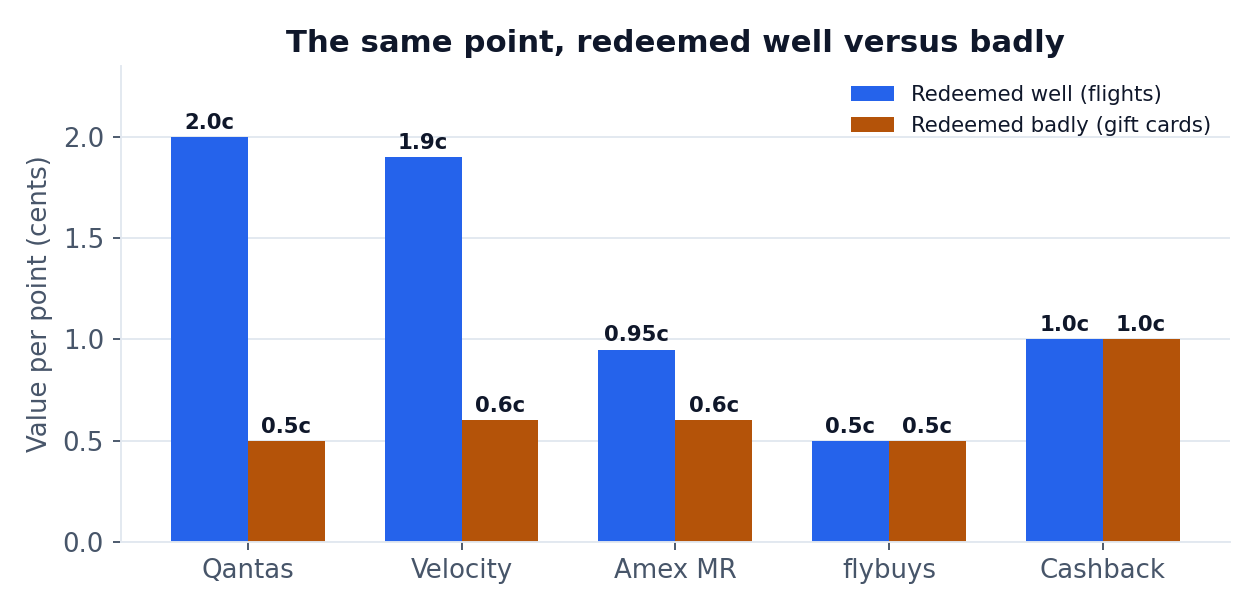
Two columns run through every table: what the card returns if you redeem well, and what it returns if you redeem badly. The gap between them is usually larger than the difference between any two cards.
| Points currency | Redeemed well (flights) | Redeemed badly (gift cards, store) | Basis |
|---|---|---|---|
| Qantas Points | 2.0c | 0.5c | Economy Classic Reward typical value; Qantas Store and gift cards 0.45 to 0.5c. See how much Qantas Points are worth. |
| Velocity Points | 1.9c | 0.6c | Middle of the 1.7 to 2.1c economy band; non-flight 0.5 to 0.7c. See how much Velocity Points are worth. |
| Amex Membership Rewards | 0.95c | 0.6c | 2:1 transfer to Velocity at 1.9c per Velocity Point; cash-out and gift cards 0.5 to 0.7c. See the transfer ratios register. |
| flybuys points | 0.5c | 0.5c | flybuys’ standard 2,000 points = $10 rate. There is no better redemption to find. |
| Cashback | 1.0c | 1.0c | A dollar is a dollar. |
If you value points differently, the tables still work: divide the fee by your earn rate times your own point value.
Break-even spend by card
Everyday earn rate only. Bonus categories, sign-up bonuses and fee offsets like travel credits are deliberately excluded from the break-even column and listed separately, because they either apply to a slice of spend or only once. Where an earn rate is capped, the break-even falls inside the cap unless stated.
| Card | Annual fee | Everyday earn | Return per $1 (flights) | Break-even spend (flights) | Break-even spend (gift cards) | Fee offsets not counted |
|---|---|---|---|---|---|---|
| Qantas American Express Ultimate | $450 | 1.25 Qantas Points | 2.5c | $18,000 | $72,000 | $450 Qantas Travel Credit each year, which cancels the fee outright if you use it |
| Qantas Premier Platinum | $399 ($349 first year) | 1.0 Qantas Point, to $10,000 per statement then 0.5 | 2.0c | $20,000 ($17,500 first year) | $79,800 | Two Qantas Club lounge invitations a year |
| Qantas Premier Everyday | $99 | 0.75 Qantas Points, to $3,000 per statement then 0.4 | 1.5c | $6,600 | $26,400 | None |
| Qantas Premier Titanium | $1,200 | 1.25 Qantas Points, to $12,500 per statement then 0.5 | 2.5c | $48,000 | $192,000 | Lounge and status benefits |
| NAB Qantas Rewards Signature † | $449 | 0.75 Qantas Points to $3,000 per statement, 0.25 to $15,000, then nothing | 1.5c | $29,900 | Never: the cap limits you to about $315 of gift-card value a year | $100 off the first year for existing NAB customers |
| NAB Qantas Rewards Premium † | $295 | 0.5 Qantas Points to $3,000 per statement, 0.25 to $6,000, then nothing | 1.0c | $29,500 | Never: the cap limits you to about $135 of gift-card value a year | None |
| Amex Velocity Platinum | $440 | 1.25 Velocity Points, uncapped | 2.4c | $18,500 | $58,700 | Complimentary domestic return flight each year plus Virgin lounge passes |
| Amex Velocity Escape Plus | $95 | 1 Velocity Point until 12,000 points earned in a calendar year, then 0.75 | 1.9c | $5,000 | $17,100 | None |
| Virgin Money Velocity Flyer † | $169 | 0.5 Velocity Points to $1,500 per statement, then 0.25 | 0.95c | $17,800 | $94,700 | $129 Virgin Australia voucher a year, which cuts the flight break-even to about $4,200 |
| Virgin Money Velocity High Flyer † | $349 | 0.75 Velocity Points to $5,000 per statement, then 0.25 | 1.4c | $24,500 | $112,700 | $129 Virgin voucher plus two lounge passes; the voucher alone brings break-even to about $15,400 |
| Amex Explorer | $395 | 2 Membership Rewards, uncapped | 1.9c | $20,800 | $32,900 | $400 Amex Travel Credit a year, which is more than the fee. See is the Amex Explorer worth it |
| Amex Platinum Edge | $195 ($0 first year online) | 1 Membership Rewards point; 3 at major supermarkets and petrol stations | 0.95c everyday, 2.85c on groceries and fuel | $20,500 if none of it is groceries or fuel; $6,800 if all of it is | $32,500 | None currently listed |
| Coles Rewards Mastercard † | $99 | 1 flybuys point everywhere; 2 on Coles spend only; capped at the first $8,000 per statement | 0.5c (1.0c at Coles) | $19,800 if none of it is Coles spend; $9,900 if all of it is | Same (flybuys has one value) | None |
| Coles No Annual Fee Mastercard | $0 | 1 flybuys point per $2 to $5,000 per statement | 0.5c | $0 | $0 | None needed |
| MONEYME Cashback Rewards | $149 | 1% cashback, capped at 1% of your credit limit each month | 1.0c | $14,900 | $14,900 | None |
| ING Orange One Rewards Platinum | $149 | 1% cashback, capped at $30 a month | 1.0c | $14,900 | $14,900 | None, and the cap means you can never net more than $211 a year |
Break-even figures are rounded to the nearest $100. Statement-period caps are treated as monthly. The Westpac Altitude cards use category-based earn rates that changed in 2025 and change again on 30 September 2026, and the NAB Rewards cards earn a bank currency whose Velocity conversion drops from 2:1 to 3:1 on 1 October; both families will be added after the October re-check rather than guessed at now.
What you actually clear at $30,000, $60,000 and $100,000 a year
Break-even tells you where zero is. This table tells you what is left after the fee at three realistic spend levels, using the flight values above and applying every cap. Fee offsets are still excluded, so add the travel credit or voucher back in yourself if you will genuinely use it.
| Card | Net at $30,000 | Net at $60,000 | Net at $100,000 |
|---|---|---|---|
| Qantas American Express Ultimate | $300 | $1,050 | $1,950 |
| Qantas Premier Platinum | $201 | $801 | $1,601 |
| Qantas Premier Everyday | $351 | $633 | $953 |
| Qantas Premier Titanium | -$450 | $300 | $1,300 |
| NAB Qantas Rewards Signature † | $1 | $211 | $411 |
| NAB Qantas Rewards Premium † | $5 | $185 | $245 |
| Amex Velocity Platinum | $273 | $985 | $1,935 |
| Amex Velocity Escape Plus | $390 | $817 | $1,387 |
| Virgin Money Velocity Flyer † | $59 | $202 | $392 |
| Virgin Money Velocity High Flyer † | $79 | $506 | $696 |
| Amex Explorer | $175 | $745 | $1,505 |
| Amex Platinum Edge (all spend at 1 point per $1) | $90 | $375 | $755 |
| Coles Rewards Mastercard † (no Coles spend) | $51 | $201 | $381 |
| Coles No Annual Fee Mastercard | $75 | $150 | $150 |
| MONEYME Cashback Rewards | $151 | $451 | $851 |
| ING Orange One Rewards Platinum | $151 | $211 | $211 |
Three things jump out. First, at $30,000 a year the cheap cards win: the $95 Escape Plus and the $99 Premier Everyday both clear more than the $450 Ultimate does, because a low fee is easier to cover than a high earn rate is to exploit. Second, the ranking flips completely by $100,000, where the uncapped high-earners pull away and the capped cards flatline. Third, the Titanium is the only card on the list that loses money at $30,000, and it needs roughly $48,000 just to get back to zero. Fourth, from 1 October both NAB Qantas cards and both Virgin Money cards are close to worthless at $30,000: the NAB Qantas Signature clears $1 and the Premium $5 after their new fees and rates.
The Platinum Edge deserves its own note. Its everyday rate is poor at 0.95 cents, but every $1,000 you put through a major supermarket or petrol station adds about $19 of value on top. Someone spending $30,000 with $10,000 of that on groceries and fuel nets about $280, not $90, which moves it from the bottom of the table to the middle. See our best card for petrol guide if that is your spend pattern.
What changes on 1 October 2026
The Reserve Bank’s surcharge reforms take effect on 1 October 2026 and cut the interchange revenue that funds points. NAB, Virgin Money and Coles have all issued variation notices dated to that day; Westpac’s changes land a day earlier. These are the old and new figures for the cards on this page, from the issuers’ own notices.
| Card | Until 30 September 2026 | From 1 October 2026 | Break-even on flights, old to new |
|---|---|---|---|
| NAB Qantas Rewards Signature | $420; 1.0 point to $5,000 per statement, 0.5 to $20,000 | $449 for new applicants; 0.75 point to $3,000, 0.25 to $15,000 | $21,000 to $29,900 |
| NAB Qantas Rewards Premium | $295; 0.67 point to $3,000, 0.5 to $6,000 | $295; 0.5 point to $3,000, 0.25 to $6,000 | $22,100 to $29,500 |
| Virgin Money Velocity Flyer | $149; 0.66 point to $1,500, then 0.5 | $169; 0.5 point to $1,500, then 0.25 | $11,900 to $17,800 |
| Virgin Money Velocity High Flyer | $329; 1.0 point to $8,000, then 0.5 | $349; 0.75 point to $5,000, then 0.25 | $17,300 to $24,500 |
| Coles Rewards Mastercard | $99; 2 flybuys points on everything to $3,000, 1 to $8,000 | $99; 2 points on Coles spend only, 1 everywhere else, capped at $8,000 | $9,900 to $19,800 on non-Coles spend |
| Westpac Altitude Qantas Black | $295 card fee plus $75 Qantas program fee | $295 plus $155 (from 30 September) | Not on this page; earn rate not verified |
The pattern is the same everywhere: the earn rate on the first few thousand dollars drops by a quarter to a third, the tier above it is halved, and the fee goes up. The cards that were only just paying their way at $30,000 of spend now barely cover the fee at all. Purchase interest rates also rise on the same day, to 21.99 percent at Virgin Money and Coles and 22.49 percent at NAB, which makes the pay-in-full rule below even less optional. The Amex cards, the Qantas Money Premier cards and the two cashback cards have announced no changes.
The two things that change the answer more than the card does
How you redeem. Compare the two break-even columns in the main table. The Qantas Amex Ultimate breaks even at $18,000 of spend on flights and $72,000 on gift cards. That is not a small adjustment, it is a different product. If you know from experience that your points end up as a Qantas Store toaster, the honest break-even for you is the right-hand column, and on that column a plain cashback card beats every points card on this page. Our points vs cash calculator lets you put your own redemption habit in.
Whether you use the fee offset. Three cards carry credits or vouchers that wipe most or all of the fee before a single point is counted: the Ultimate’s $450 travel credit, the Explorer’s $400 travel credit and the $129 Virgin voucher on both Virgin Money cards. Used, they turn the Ultimate and Explorer into effectively free cards with a positive return from the first dollar. Unused, they are marketing. Each credit has conditions, usually a single booking through the issuer’s travel portal within the card year with no carry-forward, and the people who forget are subsidising the people who remember. Read how to use the Amex travel credit before you count on it.
Why sign-up bonuses are left out
A 50,000 to 150,000 point bonus is worth $1,000 to $3,000 at flight value and dwarfs every number on this page in year one. It is also a one-off. Break-even is a year-two question: the bonus is gone, the fee comes round again, and the only thing left is your spend times the earn rate. Choosing a card on the bonus and keeping it on the break-even are two separate decisions, and this page is for the second one. If you want the first, our best Qantas points cards and best Velocity cards guides cover current offers.
The maths only works if you pay in full
Rewards cards charge 20 to 24 percent on purchases. Carry a $3,000 balance for a year on a 21 percent card and the interest is about $630, which is more than the best net return in the $30,000 column. Nothing above survives a revolving balance. If you do not clear the card every month, the right card is a low-rate card with no fee, and points are irrelevant. Approval for any card is subject to the lender’s criteria.
Run your own number
The card worth it calculator does the fee, earn rate and point value sum with your actual spend and shows the break-even and net return for any card, including ones not on this page. For a full points-to-flights view, see how many points you need for a flight.
FAQ
How much do I need to spend to justify a credit card annual fee?
Divide the annual fee by the earn rate times the point value. For a typical Australian frequent flyer card earning 1 point per dollar at 2 cents a point, that is the fee divided by $0.02, so a $399 fee needs about $20,000 of annual spend and a $99 fee needs about $5,000. High-earn Amex cards at 1.25 points per dollar need about 20 percent less.
Is a $450 annual fee credit card worth it?
On points alone, the Qantas American Express Ultimate at $450 breaks even at roughly $18,000 of annual spend redeemed on flights. Its $450 Qantas Travel Credit cancels the fee entirely if you book one eligible Qantas flight through Amex Travel each year, at which point the card is ahead from the first dollar. If you will not use the credit and you redeem points on gift cards, it needs about $72,000 of spend, and it is not worth it.
What changes for rewards cards on 1 October 2026?
NAB cuts the NAB Qantas Rewards Signature to 0.75 points per dollar on the first $3,000 a month and raises the fee to $449 for new applicants, and cuts the Premium to 0.5 points. Virgin Money raises the Velocity Flyer to $169 and the High Flyer to $349 while cutting both earn rates by about a quarter. Coles restricts the Rewards Mastercard’s 2-points rate to Coles spend only. Westpac raises the Altitude Qantas program fee from $75 to $155 on 30 September. American Express, Qantas Money, MONEYME and ING have announced no changes.
Which rewards card has the lowest break-even?
Among cards with a fee, the Amex Velocity Escape Plus at $95 breaks even at about $5,000 of spend and the Qantas Premier Everyday at $99 at about $6,600. The Coles No Annual Fee Mastercard has no fee, so it is ahead from the first dollar, but it earns only 0.5 cents per dollar.
Does the sign-up bonus count toward break-even?
Not on this page, deliberately. The bonus is a year-one event that typically covers the fee several times over. Break-even is about whether the card justifies its fee every year after that, when there is no bonus and only your spend.
How does a points cap change the break-even?
A cap limits how many points you can earn, so it puts a ceiling on the return regardless of spend. The NAB Qantas Rewards Premium earns nothing beyond $6,000 per statement period, which caps its yearly return at about $840 on flights and $210 on gift cards. At gift-card value it can never cover its $295 fee, no matter how much you spend.
Is cashback better than points for covering an annual fee?
It depends entirely on how you redeem. At flight value, a 1 point per dollar Qantas card returns 2 cents per dollar, double a 1 percent cashback card. At gift-card value it returns 0.5 cents, half. If your points reliably become flights, points win; if they become gift cards, take the cash. Our cashback cards comparison covers the cash side.
Related guides & tools
- Best rewards card if you don’t fly business class
- Best Qantas points credit cards
- Best Velocity credit cards
- Best cashback credit cards in Australia
- Best no-annual-fee rewards credit card
- Is this card worth it? calculator (free tool)
- Points vs cashback calculator (free tool)