The ten-second check the points forums do by hand: enter the cash fare, the points price and the taxes on the points booking, and get the cents-per-point verdict. Above 1.2c for domestic economy, the points booking is doing its job; below 1c, pay cash and keep your points for a better day.
Why 1.2c is the benchmark: how much Qantas Points are worth. Building the balance: best Qantas cards · best Velocity cards.
Common questions
Should I book a flight with points or cash?
Compare the cents-per-point you would get (the cash fare minus taxes, divided by the points required) against a sensible benchmark of about 1.2 cents. Above the benchmark, points win; below it, pay cash and keep your points.
Why 1.2 cents?
It is a realistic everyday value for Qantas and Velocity points on economy reward seats, which is the redemption most Australians actually make.
The check that settles it in ten seconds
Every “should I pay points or cash” argument comes down to one number: how many cents of value you get per point on this specific booking. Work it out and the decision makes itself.
(cash fare - taxes payable on the points booking) / points required x 100 = cents per point
The subtraction is the part people skip. A points booking is rarely free - you still pay taxes and carrier charges in cash - and those charges come off the value the points are delivering, not out of thin air.
Where the line sits
For domestic economy, a rough working threshold is around 1.2c per point. Above it, the points booking is doing its job. Below about 1c, pay cash and keep the points for a redemption that uses them better. These are not laws of physics - they are the rate you can reliably get elsewhere on the same points, which is what makes them a fair benchmark.
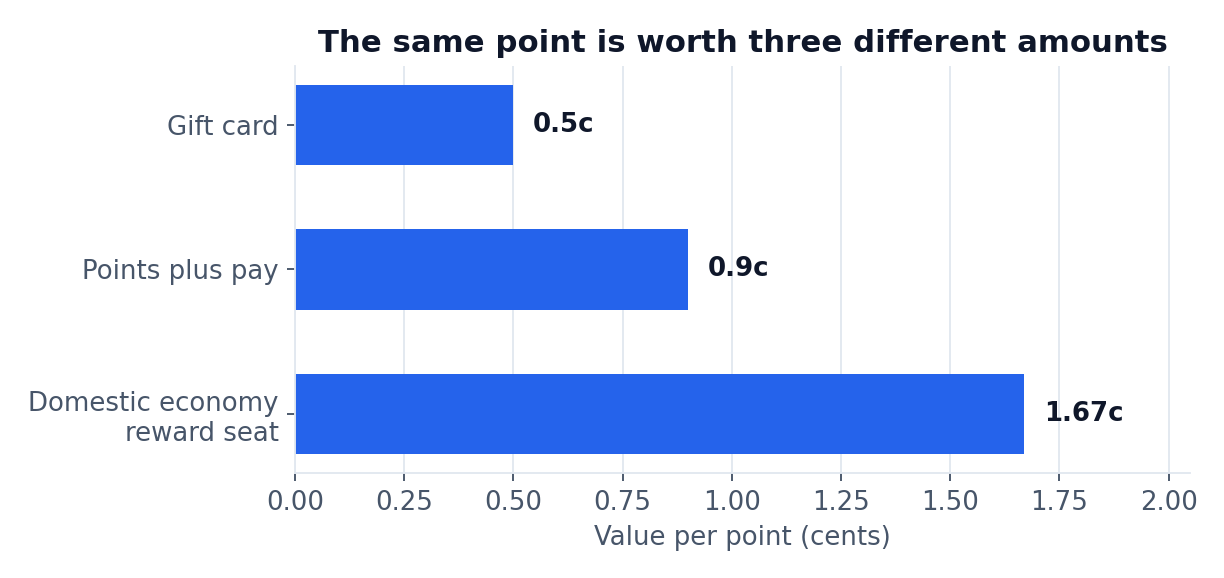
The logic: if the alternative use of those points is a gift card at roughly half a cent, then anything well above that is a win. If the alternative is a premium cabin redemption at 2c or more, then burning them at 1.1c on a cheap domestic hop is a waste, even though 1.1c looks fine in isolation.
A worked example
A Sydney to Melbourne flight is $189 in cash, or 8,000 points plus $25 in taxes. That is (189 - 25) / 8,000 = 2.05c per point. Comfortably above the line - use the points.
Same route on a sale day at $99 cash, same 8,000 points plus $25: (99 - 25) / 8,000 = 0.93c. Below the line - pay the $99 and keep the points. The route did not change, the airline did not change, and the right answer flipped entirely because of the cash fare.
When the answer changes
- Refundability. Reward bookings are often easier and cheaper to change than a cheap cash fare. If plans might move, that flexibility is worth real money and does not show up in cents per point.
- Status credits. Reward seats typically earn no status credits. If you are chasing status, a cash fare does two jobs.
- Expiring points. If the balance is about to lapse, almost any redemption beats zero.
- A trip you would not otherwise take. If you would not have paid the cash fare, you are not saving it. Value the redemption honestly or accept you are buying an experience.
- Cash you do not have. Points can be the difference between going and not going. That is a legitimate reason even at a poor rate.
Common questions
Is 1.2c a hard rule?
No - it is a benchmark for domestic economy based on what those points reliably fetch elsewhere. Premium cabin redemptions should clear a much higher bar before you call them good.
Should I include the booking fee?
Include every dollar you pay in cash on the points booking. Taxes, carrier charges, card surcharges and booking fees all reduce the value the points are delivering.
What about points-plus-pay?
Run the same formula treating the cash component as cash payable. Points-plus-pay options usually come out at a poor rate, which is exactly why they are offered so prominently.
What are my points worth in general?
Use the Qantas points calculator or the Velocity points calculator to see the full redemption spread.