
Verdict up front: The Amex Velocity Platinum ($440/year) is the strongest direct-earn Velocity card - 1.25 points per $1 and up to 2.25 on Virgin Australia spend. On a budget, the Amex Velocity Escape Plus ($95) earns a clean 1 point per $1, and the Virgin Money Velocity High Flyer ($329) is the non-Amex pick. But the under-rated path is indirect: flexible points (Amex Membership Rewards, NAB Rewards) transfer to Velocity at 2:1, and Flybuys feeds it free from your Coles shop at the same ratio. Velocity is the easier program to actually use for everyday Australians - reward seats on domestic routes are more findable than Qantas - so the right card matters less than just picking a lane and feeding it.
Last updated: June 2026 | [Affiliate disclosure: I earn a commission if you apply via my links - it never affects which cards I recommend.]
Qantas cards get all the marketing budget, but for everyday Australians who fly domestic a few times a year, Velocity points are frequently the better currency: similar point values, friendlier reward availability on the routes you actually fly, and a free feed from Coles via Flybuys.
Here are the cards that earn them, ranked honestly.
The shortlist
1. Amex Velocity Platinum - best direct earner
- Annual fee: $440
- Earn rate: 1.25 Velocity Points per $1 on eligible spend · up to 2.25 points per $1 with Virgin Australia
- Who it’s for: Spenders of $2,500+/month whose shops take Amex
The highest standing everyday earn in the Velocity world, with a meaningful boost when you book Virgin directly. Check the current offer for the sign-up bonus and any included flight benefits - the extras change; the earn rate is the constant.
The catch I want to be upfront about: the usual Amex acceptance gap, and a $440 fee that needs real spend behind it. At 1.25 points per $1 with Velocity points worth roughly 1-1.5c redeemed on domestic flights, break-even sits around $2,400-$2,900/month of card spend - before any bonus or Virgin-spend boost.
➡️ Check the current Amex Velocity Platinum offer → (affiliate link)
2. Amex Velocity Escape Plus - best on a budget
- Annual fee: $95
- Earn rate: 1 Velocity Point per $1 on eligible spend (capped - check the current threshold)
- Who it’s for: Spenders under $2,500/month who want Velocity earn without a premium fee
A clean, cheap earner. At $2,000/month you’re making ~24,000 Velocity Points a year - $240-$360 of flight value against a $95 fee. The maths clear comfortably at spend levels where the Platinum’s $440 fee drowns.
➡️ Check the current Amex Velocity Escape Plus offer → (affiliate link)
3. Virgin Money Velocity High Flyer - best non-Amex option
- Annual fee: $329
- Earn rate: 1 Velocity Point per $1, capped at $8,000 per statement period
- Who it’s for: Velocity collectors who want Visa/Mastercard acceptance everywhere
The straightforward Visa-side answer. The $8,000 monthly full-earn band covers nearly every household, and the acceptance question disappears. Virgin Money also runs a cheaper Velocity Flyer tier (category-based earn with caps - check the current structure) if the fee feels heavy.
➡️ Check the current Virgin Money High Flyer offer → (affiliate link)
The indirect paths most guides skip
Flexible points → Velocity at 2:1
- Amex Membership Rewards (Explorer, Platinum Edge): 2 MR points = 1 Velocity Point. The Platinum Edge earning 3 MR per $1 at supermarkets and petrol is effectively 1.5 Velocity Points per $1 on groceries - higher than any direct-earn Velocity card manages on the same spend.
- NAB Rewards: 2 NAB points = 1 Velocity Point, with auto-transfer available.
My take: if groceries and petrol dominate your spending, a Platinum Edge transferred to Velocity quietly out-earns the entire direct-earn shortlist above. The direct cards win on general spend and Virgin-booking boosts; the flexible cards win at the supermarket. This is the comparison that actually decides it for most households.
The free feed: Flybuys
Scan Flybuys at Coles, convert at 1,000 Flybuys = 500 Velocity Points - and watch for the periodic 15-20% transfer bonuses. A $200/week Coles household generates ~2,600 Velocity Points a year for free, before any card. Details in the Coles and Flybuys guide.
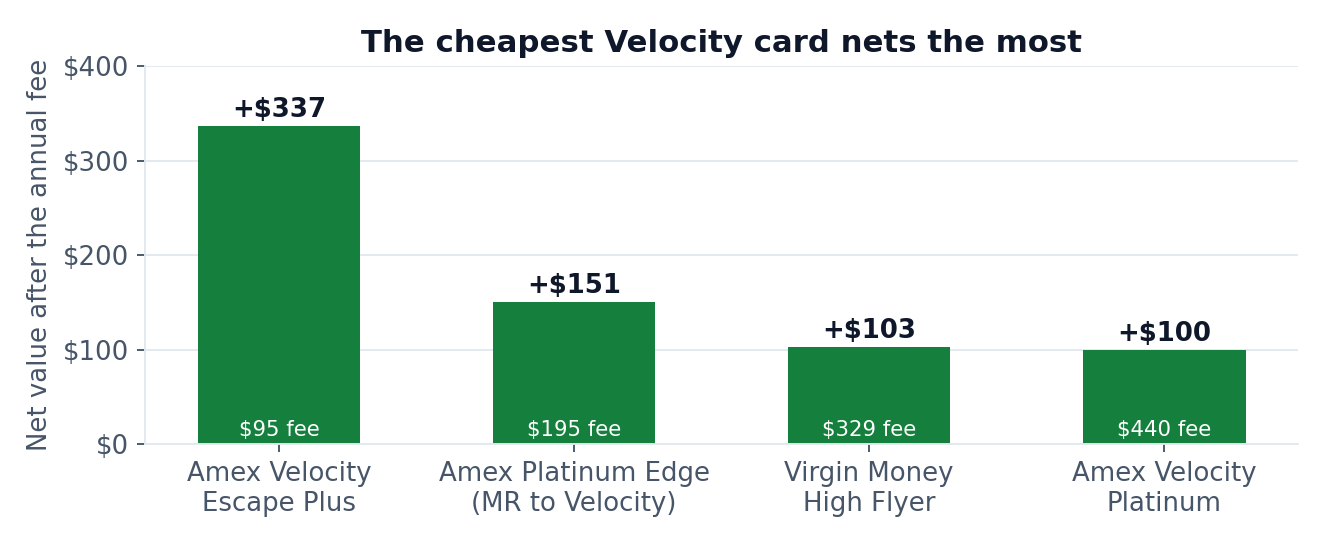
The maths: $3,000/month of card spend ($800 groceries, $200 petrol, $2,000 other)
Velocity points valued at 1.2c (fair domestic redemption).
| Card | Velocity pts/year | Value | Fee | Net |
|---|---|---|---|---|
| Amex Velocity Platinum | 45,000 | $540 | $440 | +$100 |
| Amex Velocity Escape Plus | 36,000 | $432 | $95 | +$337 |
| Virgin Money High Flyer | 36,000 | $432 | $329 | +$103 |
| Amex Platinum Edge (MR→Velocity 2:1) | ~28,800 | $346 | $195 | +$151 |
My take on this table: at everyday spend levels the budget Escape Plus wins outright - the premium cards need bigger spend, heavy Virgin bookings, or their sign-up bonuses to justify the fee gap. This is the part the commission-sorted comparison sites won’t show you: in the Velocity world, cheaper is usually better.
Don’t get a Velocity card if…
- You fly Qantas/Jetstar - wrong currency; see the Qantas card roundup or the program comparison
- You carry a balance - interest beats points, always
- You spend under $1,500/month - scan Flybuys free, convert to Velocity, pay with a no-fee card
- You’d redeem for gift cards - ~0.5c a point; get a simpler setup via the non-traveller hub
The one question that decides it
Where does your spending happen - everywhere, or mostly the supermarket?
Mostly supermarket and petrol → Amex Platinum Edge, transferred to Velocity at 2:1. Highest grocery earn in the program.
Spread everywhere, under $2,500/month → Amex Velocity Escape Plus ($95).
Spread everywhere, over $2,500/month → Amex Velocity Platinum if Amex suits, Virgin Money High Flyer if not.
FAQ
Which credit card earns the most Velocity points?
The Amex Velocity Platinum earns the most on general spend (1.25 points per $1, up to 2.25 with Virgin Australia). On supermarket-heavy budgets, the Amex Platinum Edge transferred at 2 Membership Rewards to 1 Velocity point effectively earns 1.5 Velocity points per $1 on groceries - more than any direct-earn card manages there.
Do Velocity credit cards have annual fees?
The main direct earners run $95 (Amex Velocity Escape Plus) to $440 (Amex Velocity Platinum), with Virgin Money’s High Flyer at $329. At typical household spend the cheaper cards usually net more after fees.
Can I convert other points to Velocity?
Yes - Amex Membership Rewards and NAB Rewards both transfer at 2:1, and Flybuys converts at 1,000 Flybuys to 500 Velocity Points. Both Flybuys and the banks run periodic transfer bonuses worth waiting for on big conversions.
Do Velocity points expire?
Velocity points expire under the program’s inactivity rules (around 24 months - check Velocity’s current terms). Any earn or redemption resets the clock, so a linked Flybuys conversion or card earn keeps the balance alive.
Are Velocity points worth more than Qantas points?
Per point they’re similar (roughly 1-1.5c on well-chosen domestic redemptions). Velocity’s practical edge is reward seat availability on domestic routes; Qantas’s edge is network breadth and earning partners. The full comparison: Velocity vs Qantas Points.
How many Velocity points do I need for a flight?
Short domestic hops start around 7,800 points one-way plus taxes; Sydney-Melbourne sits near that mark, with longer routes scaling up. A single card sign-up bonus typically covers two to four domestic one-ways.
← All guides | Velocity vs Qantas Points → | Best Qantas points credit cards → | Hub: best rewards card if you don’t fly business class →
This article is general information only. Credit cards are financial products - consider whether each product suits your personal circumstances and read the product disclosure statement before applying. Fees, earn rates and offers are accurate at time of publishing and subject to change. I earn a commission if you apply via the affiliate links on this page.
{
“@context”: “https://schema.org”,
“@type”: “FAQPage”,
“url”: “https://worthitcards.com.au/best-velocity-credit-cards/”,
“mainEntity”: [
{
“@type”: “Question”,
“name”: “Which credit card earns the most Velocity points?”,
“acceptedAnswer”: {
“@type”: “Answer”,
“text”: “The Amex Velocity Platinum earns the most on general spend (1.25 points per $1, up to 2.25 with Virgin Australia). On supermarket-heavy budgets, the Amex Platinum Edge transferred at 2 Membership Rewards to 1 Velocity point effectively earns 1.5 Velocity points per $1 on groceries - more than any direct-earn card manages there.”
}
},
{
“@type”: “Question”,
“name”: “Do Velocity credit cards have annual fees?”,
“acceptedAnswer”: {
“@type”: “Answer”,
“text”: “The main direct earners run $95 (Amex Velocity Escape Plus) to $440 (Amex Velocity Platinum), with Virgin Money’s High Flyer at $329. At typical household spend the cheaper cards usually net more after fees.”
}
},
{
“@type”: “Question”,
“name”: “Can I convert other points to Velocity?”,
“acceptedAnswer”: {
“@type”: “Answer”,
“text”: “Yes - Amex Membership Rewards and NAB Rewards both transfer at 2:1, and Flybuys converts at 1,000 Flybuys to 500 Velocity Points. Both Flybuys and the banks run periodic transfer bonuses worth waiting for on big conversions.”
}
},
{
“@type”: “Question”,
“name”: “Do Velocity points expire?”,
“acceptedAnswer”: {
“@type”: “Answer”,
“text”: “Velocity points expire under the program’s inactivity rules (around 24 months - check Velocity’s current terms). Any earn or redemption resets the clock, so a linked Flybuys conversion or card earn keeps the balance alive.”
}
},
{
“@type”: “Question”,
“name”: “Are Velocity points worth more than Qantas points?”,
“acceptedAnswer”: {
“@type”: “Answer”,
“text”: “Per point they’re similar (roughly 1-1.5c on well-chosen domestic redemptions). Velocity’s practical edge is reward seat availability on domestic routes; Qantas’s edge is network breadth and earning partners. The full comparison: Velocity vs Qantas Points.”
}
},
{
“@type”: “Question”,
“name”: “How many Velocity points do I need for a flight?”,
“acceptedAnswer”: {
“@type”: “Answer”,
“text”: “Short domestic hops start around 7,800 points one-way plus taxes; Sydney-Melbourne sits near that mark, with longer routes scaling up. A single card sign-up bonus typically covers two to four domestic one-ways.”
}
}
]
}
Related guides & tools