
Verdict up front: For most everyday Australians, the Amex Platinum Edge ($195/year, often $0 in Year 1) earns the most rewards on the spending you’re already doing - 3 points per $1 at both supermarkets and petrol. If you want broader card acceptance, the honest news is that no Visa or Mastercard comes close on earn rate: the NAB Rewards Platinum ($195/year) is the simplest set-and-forget option but the maths are thin, and the Coles No Annual Fee Mastercard quietly beats it on net return at most spend levels because it costs nothing. Don’t pick a card based on a sign-up bonus - pick it based on what you actually spend.
Last updated: June 2026 | [Affiliate disclosure: I earn a commission if you apply via my links - it never affects which cards I recommend.]
Most rewards card guides in Australia are written for people who fly to London in business class. They rank cards by Qantas points per dollar and assume your goal is a premium long-haul redemption.
That’s about 2% of Australians.
This guide is for the other 98% - people who spend money on groceries, fuel, bills, and the occasional domestic flight, and who’d like something meaningful back for it. No jargon. Just the numbers, and an honest answer for each situation.
Start here: pick a card by what you actually spend on
If you’re new to rewards cards, don’t read every card review on the internet. Read the one that matches what you actually do with your money.
| If most of your spend is on… | Read this | What it covers |
|---|---|---|
| Woolworths and petrol | Best credit card for Woolworths → | The October 2025 ANZ partnership changed everything here |
| Petrol and grocery shopping | Best credit card for petrol → | App + card stacking strategy |
| Coles and Flybuys | Best credit card for Coles → | The free Coles card vs the paid Coles card |
| You fly Qantas occasionally | NAB Qantas Signature review → | The cheapest Qantas Visa worth getting |
| You fly Qantas often (2+/year) | Qantas Premier Platinum review → | When the lounge passes earn their keep |
| You’d use a $400 travel credit | Amex Explorer review → | The credit makes the card effectively free |
If none of the above fits - keep reading. The four cards below are the all-purpose “best rewards card for everyday Australians” answers.
What “rewards” actually means for most people
When most Australians redeem credit card points, they redeem for:
- Woolworths or Coles gift cards / dollars off groceries
- A domestic flight (Sydney-Melbourne, Brisbane-Gold Coast)
- Cashback to the card statement
- Online shopping through points stores
Not business class to Dubai.
That changes which card makes sense. A card optimised for Qantas long-haul redemptions (where 1 point can be worth 1.5-2c) might actually deliver less value than a simpler cashback or store credit card if you’re going to redeem for gift cards (where 1 point is worth ~0.5c).
My rule: know what you’ll actually redeem for, then choose the card that earns most efficiently for that redemption.
The shortlist (for normal people)
1. Amex Platinum Edge - best for grocery + petrol households
- Annual fee: $195 (often $0 in the first year - check the current offer)
- Earn rate: 3 Amex Membership Rewards points per $1 at major supermarkets · 3 points per $1 at major petrol stations · 1 point per $1 everywhere else
- Points programs: Transfer to Qantas, Velocity, Singapore KrisFlyer, Hilton, Marriott, and more
- Who it’s for: Households spending $500+/month combined on groceries and fuel
The Platinum Edge punches well above its price tag. The 3x at supermarkets means a household spending $800/month at Woolworths or Coles earns 28,800 Amex points per year from groceries alone - worth roughly $144-$288 depending on how you redeem.
Add petrol at the same 3x and you’re realistically looking at $300-$500 in annual rewards value against a $195 fee. Net positive on most household budgets.
The catch I want to be upfront about: Amex isn’t accepted everywhere. Most major retailers and supermarkets take it, but small businesses, regional servos, and some independent cafes don’t. Pair it with a backup Visa or Mastercard for those situations.
➡️ Apply for the Amex Platinum Edge → (affiliate link)
2. NAB Rewards Platinum - simplest Visa, but run the maths first
- Annual fee: $195 (reduced first-year offers appear periodically - check the current offer)
- Earn rate: 1 NAB Rewards point per $1 on everyday purchases, with bonus rates (up to 2 points per $1) on selected categories · uncapped
- Points programs: Transfer to Velocity, Singapore KrisFlyer, or redeem for gift cards and cashback
- Who it’s for: People who want one Visa that earns transferable points and don’t want to think about category bonuses
The pitch is simplicity: a flat, uncapped base earn wherever you shop, on a Visa that’s accepted everywhere. The Velocity transfer is the redemption that makes it worthwhile - Velocity points for domestic flights are among the best redemptions available to everyday Australians.
My take - and I’ll be straight about this: at 1 point per $1, the value per dollar is thin. You need roughly $2,500+/month of card spend and a flight-points redemption habit before the $195 fee clearly pays for itself. If “one card, no thinking” is your brief and your spend is there, fine. If not, the free Coles card below returns more, for nothing.
➡️ Apply for the NAB Rewards Platinum → (affiliate link)
3. CommBank Awards - best if you already bank with CommBank
- Annual fee: $59 (base card) to $420 (Ultimate Awards)
- Earn rate: 1.5 CommBank Awards points per $1 (varies by tier)
- Points programs: Transfer to Qantas (Ultimate tier opt-in) or Velocity, or redeem for cashback, gift cards, merchandise
- Who it’s for: CommBank customers who want banking + rewards in one app
The Awards program integrates with NetBank and the CommBank app, which is convenient if you already bank there. The Yello rewards layer adds occasional bonus offers on top of base earn.
My take: the base Awards card at $59/year is genuinely good value for light to moderate spenders - it’s hard to lose money on $59 in fees if you’d put the spend on a card anyway. The Ultimate Awards at $420/year only makes sense for high spenders who want the Qantas opt-in (1 Qantas Point per $1, uncapped). At that fee level you’re competing with the Qantas Premier Platinum, which has lounge passes the CommBank doesn’t.
➡️ Apply for CommBank Awards → (affiliate link)
4. Coles No Annual Fee Mastercard - best if you mostly shop at Coles
- Annual fee: $0
- Earn rate: 1 Flybuys point per $2 (eligible purchases up to $5,000/statement period)
- Points programs: Flybuys redemption - dollars off at Coles, fuel vouchers
- Who it’s for: Coles loyalists who want Flybuys earn for free
A no-fee card that earns Flybuys is hard to beat for cost efficiency. The earn rate is modest (1 point per $2 is the lowest in this comparison), but when the annual fee is $0, the bar to justify it is also $0.
My take: this isn’t your one card. It’s your dedicated Coles card. Pair it with a higher-earning rewards card for everything else, and use it specifically when you shop at Coles or Reddy Express. See the full Coles + Flybuys comparison for whether the paid Coles Rewards Mastercard is worth the upgrade for you.
➡️ Apply for Coles No Annual Fee Mastercard → (affiliate link)
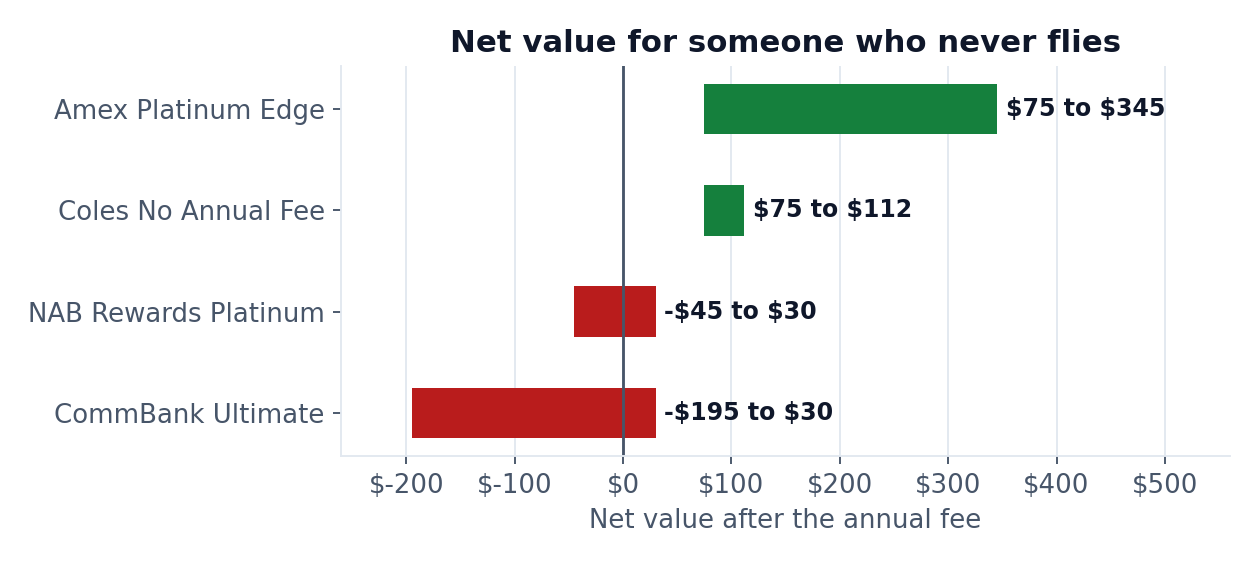
The maths: what does each card earn at $2,500/month total spend?
Assumptions: $800/month groceries, $200/month petrol, $1,500/month other. Values shown as a range: gift-card/cashback redemption first, well-redeemed frequent flyer transfer second.
| Card | Annual fee | Est. points earned | Est. points value | Net after fee |
|---|---|---|---|---|
| Amex Platinum Edge | $195 | ~54,000 MR | $270-$540 | +$75 to +$345 |
| NAB Rewards Platinum | $195 | ~30,000 NAB | $150-$225 | −$45 to +$30 |
| CommBank Ultimate Awards | $420 | ~45,000 CBA | $225-$450 | −$195 to +$30 |
| Coles No Annual Fee | $0 | ~15,000 Flybuys | $75-$112 | +$75 to +$112 |
Points values vary significantly by redemption method. Frequent flyer transfer = higher value; gift cards and cashback = lower value.
My take: at this spend level the Amex Platinum Edge wins on raw value, and - the bit other guides won’t say - the free Coles card beats both fee-charging Visas on net return. The NAB Rewards Platinum only pulls ahead of the free card if you spend well above $2,500/month and redeem via Velocity. Broad acceptance is worth something, but it isn’t worth going backwards.
The one question to ask before applying
“What will I actually do with the points?”
- “Get dollars off at Coles or Woolworths” → store-linked card or Flybuys/Everyday Rewards card
- “Domestic flights once or twice a year” → Velocity-earning cards (NAB Rewards, Amex transfer)
- “I don’t know yet” → flexible transfer-partner card (Amex MR or ANZ Rewards) keeps your options open
- “Just cashback to my statement” → none of the cards on this page. Get a flat 1.5-2% cashback Visa with no annual fee.
Don’t let a sign-up bonus drive the decision. A 70,000-point bonus is meaningless if the card’s ongoing earn rate means you’re paying $400/year in fees for $200 in rewards. The bonus covers Year 1; Year 2 onward is what matters.
Who should skip rewards cards entirely
Three situations where rewards cards lose money:
- You carry a balance month-to-month. Interest charges (18-24% p.a.) cost 10-20× what you’ll earn in rewards. A no-fee low-rate card saves more money than any rewards program.
- You spend under $1,000/month. The maths rarely stack up on cards with annual fees over $100.
- A rewards card would change your spending. If having it would push you to spend more than you otherwise would, the psychological effect cancels the benefit. Rewards cards reward you for spending you were going to do anyway - they don’t reward you for spending more.
If any of these apply to you, the right answer is a no-frills low-rate card. Not a rewards card.
Where to go next
The four cards on this page are the all-purpose “best rewards card” answers. But if you have a specific situation, one of these will help more:
- Best credit card for Woolworths → - the October 2025 ANZ partnership changed the maths for Woolworths shoppers
- Best credit card for petrol → - how to stack credit card points with PetrolSpy and Everyday Rewards fuel discount
- Best credit card for Coles → - paid Coles card vs free Coles card vs general rewards card
- Is the Amex Explorer worth it? → - when the $400 travel credit makes a $395 card free
- Is the Qantas Premier Platinum worth it? → - when lounge passes earn their fee back
- Is the NAB Qantas Signature worth it? → - same earn as the Premier Platinum, $134 cheaper
- Everyday Rewards vs Flybuys → - which loyalty program actually earns more
FAQ
What’s the best rewards card for someone who spends mostly on groceries?
The Amex Platinum Edge, which earns 3 points per $1 at major supermarkets (and the same at petrol stations) - the strongest everyday category earn available in Australia. The catch: you’ll need a backup Visa or Mastercard for places that don’t take Amex.
Are credit card rewards worth it?
For people who pay their balance in full every month and spend $1,500+/month: typically $200-$500 in annual value, yes. For people who carry a balance: no. Interest charges erase the rewards.
What’s the difference between Qantas points and Velocity points?
Both are frequent flyer currencies. Qantas points are better for international long-haul (more partner airlines, especially in Asia). Velocity is generally better value for domestic Australian flights. For everyday Australians who fly domestically once or twice a year, Velocity often delivers better redemption value per point.
What is a “points transfer partner”?
Some cards earn their own points currency (Amex Membership Rewards, ANZ Rewards) which you can then transfer to a frequent flyer program like Qantas or Velocity. Other cards earn frequent flyer points directly. Transferable points are more flexible (you choose which program later), but they usually earn at a lower base rate than direct-earn cards.
Is the Amex Platinum Edge or the NAB Rewards Platinum better?
Amex Platinum Edge wins on raw points if your big spend is groceries and petrol - 3 points per $1 at both is unmatched. NAB Rewards Platinum wins on simplicity and broader acceptance (Visa), but its 1-point-per-$1 base earn means it needs $2,500+/month of spend and good Velocity redemptions to justify the same $195 fee. If your retailers accept Amex, get the Platinum Edge and keep a no-fee Visa as backup.
Should I get two cards or just one?
Two is the sweet spot for most rewards-conscious Australians: an Amex for grocery/petrol category bonuses, and a Visa or Mastercard for places Amex isn’t accepted. One card is simpler but you give up earn rate at supermarkets and petrol. Three or more is overkill unless you’re managing serious sign-up bonuses.
← All guides | Cashback apps comparison → | Everyday Rewards vs Flybuys →
This article is general information only. Credit cards are financial products - consider whether each product suits your personal circumstances and read the product disclosure statement before applying. Interest rates, fees and terms are accurate at time of publishing and subject to change. I earn a commission if you apply via the affiliate links on this page.
{
“@context”: “https://schema.org”,
“@type”: “FAQPage”,
“url”: “https://worthitcards.com.au/best-rewards-card-non-traveller/”,
“mainEntity”: [
{
“@type”: “Question”,
“name”: “What’s the best rewards card for someone who spends mostly on groceries?”,
“acceptedAnswer”: {
“@type”: “Answer”,
“text”: “The Amex Platinum Edge, which earns 3 points per $1 at major supermarkets (and the same at petrol stations) - the strongest everyday category earn available in Australia. The catch: you’ll need a backup Visa or Mastercard for places that don’t take Amex.”
}
},
{
“@type”: “Question”,
“name”: “Are credit card rewards worth it?”,
“acceptedAnswer”: {
“@type”: “Answer”,
“text”: “For people who pay their balance in full every month and spend $1,500+/month: typically $200-$500 in annual value, yes. For people who carry a balance: no. Interest charges erase the rewards.”
}
},
{
“@type”: “Question”,
“name”: “What’s the difference between Qantas points and Velocity points?”,
“acceptedAnswer”: {
“@type”: “Answer”,
“text”: “Both are frequent flyer currencies. Qantas points are better for international long-haul (more partner airlines, especially in Asia). Velocity is generally better value for domestic Australian flights. For everyday Australians who fly domestically once or twice a year, Velocity often delivers better redemption value per point.”
}
},
{
“@type”: “Question”,
“name”: “What is a “points transfer partner”?”,
“acceptedAnswer”: {
“@type”: “Answer”,
“text”: “Some cards earn their own points currency (Amex Membership Rewards, ANZ Rewards) which you can then transfer to a frequent flyer program like Qantas or Velocity. Other cards earn frequent flyer points directly. Transferable points are more flexible (you choose which program later), but they usually earn at a lower base rate than direct-earn cards.”
}
},
{
“@type”: “Question”,
“name”: “Is the Amex Platinum Edge or the NAB Rewards Platinum better?”,
“acceptedAnswer”: {
“@type”: “Answer”,
“text”: “Amex Platinum Edge wins on raw points if your big spend is groceries and petrol - 3 points per $1 at both is unmatched. NAB Rewards Platinum wins on simplicity and broader acceptance (Visa), but its 1-point-per-$1 base earn means it needs $2,500+/month of spend and good Velocity redemptions to justify the same $195 fee. If your retailers accept Amex, get the Platinum Edge and keep a no-fee Visa as backup.”
}
},
{
“@type”: “Question”,
“name”: “Should I get two cards or just one?”,
“acceptedAnswer”: {
“@type”: “Answer”,
“text”: “Two is the sweet spot for most rewards-conscious Australians: an Amex for grocery/petrol category bonuses, and a Visa or Mastercard for places Amex isn’t accepted. One card is simpler but you give up earn rate at supermarkets and petrol. Three or more is overkill unless you’re managing serious sign-up bonuses.”
}
}
]
}
Related guides & tools