Verdict up front: Here’s what no comparison site leads with: Australia barely has true cashback credit cards. The US-style “1.5% back on everything, forever” card doesn’t really exist here. What we have instead: rewards cards whose points redeem as statement credit (usually poor value), store-credit cards dressed as cashback (Kogan), bank intro promos (“$300 back if you spend $X” - real but one-off), and Amex’s targeted statement-credit offers (genuinely good, quietly underrated). The best ongoing “cashback” setup for most Australians is actually a points card redeemed well, stacked with free cashback platforms like ShopBack and TopCashback - which is cashback on top of any card you hold.
Last updated: June 2026 | [Affiliate disclosure: I earn a commission or referral fee via the links on this page - it never affects what I recommend.]
“Cashback credit card” is one of the most-searched card terms in Australia, and almost everything ranking for it quietly bait-and-switches you to points cards. I’ll do the opposite: explain exactly what exists, what each is worth in real percentages, and what I’d actually do.
What “cashback” actually means in Australia - the four flavours
1. Intro cashback promos - real money, one-off
Banks periodically run “get $200-$400 back when you spend $X in the first 90 days” offers on low-rate and no-fee cards. These are genuine cash on your statement, and on a no-fee card a $300 intro promo is hard to argue with.
My take: treat these like sign-up bonuses - take the money, judge the card on its ongoing merits, and don’t keep a dud card out of gratitude. Offers rotate constantly; check what’s live before applying.
➡️ See current cashback card offers → (affiliate link)
2. Points redeemed as statement credit - the fine print flavour
Every rewards card technically does “cashback”: redeem your points against the statement. The catch is the rate - points redeem for cash at roughly 0.4-0.5c each, about half their value as flights. A card earning 1 point per $1 delivers roughly 0.5% cashback - then subtract the annual fee.
My take: if cash is what you want, most points cards are a bad way to get it. The exceptions are the high-earn category cards: the Amex Platinum Edge earning 3 points per $1 at supermarkets and petrol is roughly 1.5% back on groceries even at cash-redemption rates - decent, though still better redeemed as flights.
3. Store-credit cards dressed as cashback
The Kogan Money card is the best-known: it earns Kogan Rewards redeemable at Kogan.com - store credit, not cash. Fine if you genuinely shop there; not cashback in any meaningful sense.
4. Amex Offers - the quietly good one
Every Amex (including no-fee ones) gets rotating targeted statement-credit offers in the app: “spend $100 at this retailer, get $20 back” style. Activate, spend as normal, credit lands automatically. Regular Amex holders bank $100-$300 a year from offers they’d have spent on anyway.
My take: this is the closest thing Australia has to a genuine ongoing cashback program, and nobody markets it because no comparison site gets paid when you use it.
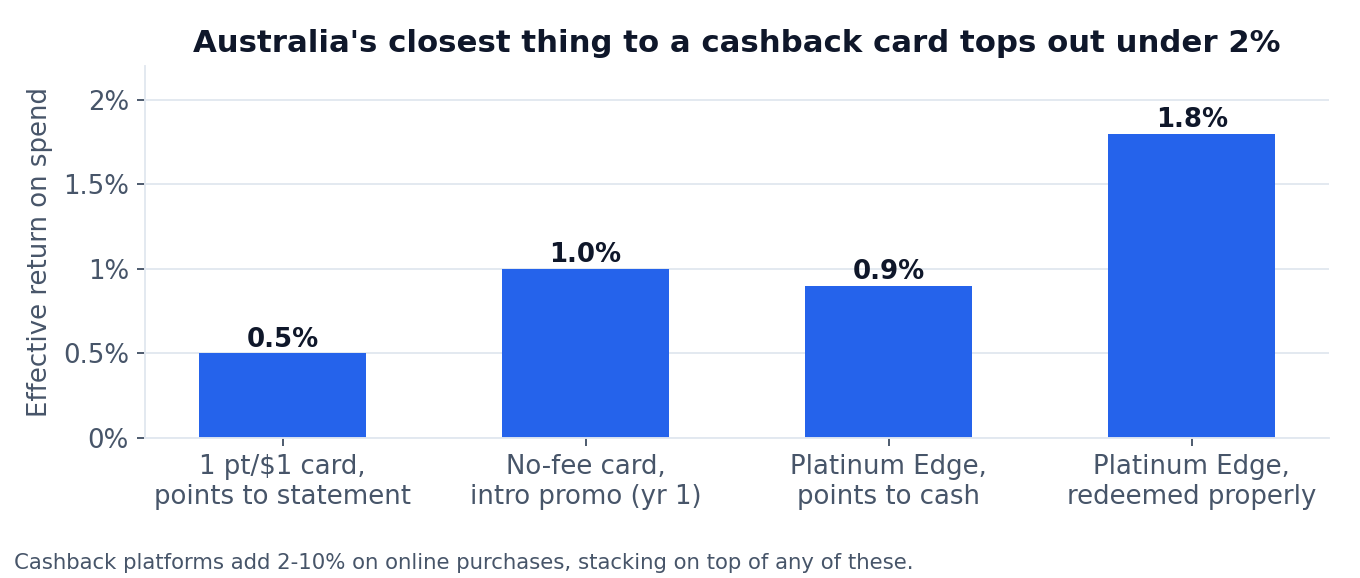
The maths: what does each setup return on $2,500/month?
$30,000/year of card spend: $800/month groceries, $200 petrol, $1,500 other.
| Setup | Effective return | Annual value | Notes |
|---|---|---|---|
| No-fee card + intro $300 promo | ~1% (year one) | ~$300 yr 1, ~$0 after | One-off |
| 1 pt/$1 card, points to statement credit | ~0.5% | ~$150, minus fee | The “default” most people hold |
| Amex Platinum Edge, points to cash | ~0.9% blended | ~$270 - $195 fee = $75 | Cash redemption wastes it |
| Amex Platinum Edge, points to flights | ~1.8% blended | ~$540 - $195 fee = $345 | Same card, redeemed properly |
| Any card + cashback platforms on online spend | +2-10% on online purchases | +$200-$600 | Stacks with all of the above |
My take on this table: the single biggest “cashback” lever in Australia isn’t a credit card at all - it’s clicking through ShopBack, TopCashback or Aura before online purchases, which stacks on top of whatever card you pay with. The second biggest is redeeming points as flights instead of cash. Card choice is third.
So what would I actually do?
- Want simple, no fee, some return? A no-fee card with a current intro cashback promo + sign up to the cashback platforms (free). Modest, honest, zero risk of an annual fee outrunning your rewards.
- Spend $500+/month on groceries and petrol? The Amex Platinum Edge - and promise yourself you’ll redeem for flights, not statement credit.
- Already hold any Amex? Open the app and start activating Amex Offers. Free money you’re currently ignoring.
- Shopping online without a cashback platform? You’re leaving 2-10% on the table on every purchase, regardless of your card. Fix that first - it’s free. Full comparison here.
Don’t chase cashback cards if…
- You carry a balance - 20%+ interest swamps a sub-1% return instantly; a low-rate card saves you far more than any cashback earns
- The promo would make you overspend - “$300 back when you spend $5,000” is a loss if you weren’t going to spend $5,000
- You’re comparing against your mortgage offset - parking money there is a guaranteed, tax-free ~6%; no card competes
The one question that decides it
Do you want cash specifically, or do you want maximum value back?
Cash specifically → no-fee card with a live intro promo + cashback platforms + Amex Offers if you hold one.
Maximum value → category-bonus points card redeemed as flights, with the platforms stacked on top. The non-traveller hub ranks them.
FAQ
Are there any true cashback credit cards in Australia?
Not in the ongoing US sense. Australian “cashback” is intro promos ($200-$400 one-off), points redeemed as statement credit (~0.5% effective), store-credit cards like Kogan, and Amex’s targeted statement-credit offers. The closest ongoing equivalents are Amex Offers plus cashback platforms stacked on any card.
What’s the catch with bank cashback promos?
They’re one-off, they require a minimum spend, and they’re designed to recruit you to a card whose ongoing value might be poor. Take the promo if the spend is natural for you, then judge the card on its merits at the first annual fee.
Is the Kogan Money card real cashback?
It earns Kogan Rewards - credit redeemable at Kogan.com. If you shop there regularly it has value; it isn’t cash and you can’t pay your electricity bill with it.
How do I get cashback without changing credit cards?
Two free moves: sign up to ShopBack, TopCashback and Aura and click through before every online purchase (2-10% back, stacks with card rewards), and if you hold any Amex, activate the rotating Amex Offers in the app. Both work with the cards already in your wallet.
Is cashback better than points?
Cash is simpler and guaranteed; points are worth more if - and only if - you redeem for flights. As cashback, a typical points card returns ~0.5%; redeemed well it can exceed 1.5%. If you know you’ll never bother with flight redemptions, optimise for cash and keep fees at zero.
Do cashback credit cards affect credit score?
The same as any card: an application adds an enquiry, a new account changes your file. The cashback itself has no effect. Apply for one card at a time and pay it in full.
← All guides | ShopBack vs TopCashback vs Aura → | Is ShopBack legit? → | Hub: best rewards card if you don’t fly business class →
Looking for cashback sites rather than cashback cards? That is a different thing and usually pays better: see the TopCashback Australia review and ShopBack vs TopCashback vs Aura.
This article is general information only. Credit cards are financial products - consider whether each product suits your personal circumstances and read the product disclosure statement before applying. Offers are accurate at time of publishing and subject to change. I earn a commission or referral fee via the affiliate links on this page.
{
“@context”: “https://schema.org”,
“@type”: “FAQPage”,
“url”: “https://worthitcards.com.au/best-cashback-credit-cards-australia/”,
“mainEntity”: [
{
“@type”: “Question”,
“name”: “Are there any true cashback credit cards in Australia?”,
“acceptedAnswer”: {
“@type”: “Answer”,
“text”: “Not in the ongoing US sense. Australian “cashback” is intro promos ($200-$400 one-off), points redeemed as statement credit (~0.5% effective), store-credit cards like Kogan, and Amex’s targeted statement-credit offers. The closest ongoing equivalents are Amex Offers plus cashback platforms stacked on any card.”
}
},
{
“@type”: “Question”,
“name”: “What’s the catch with bank cashback promos?”,
“acceptedAnswer”: {
“@type”: “Answer”,
“text”: “They’re one-off, they require a minimum spend, and they’re designed to recruit you to a card whose ongoing value might be poor. Take the promo if the spend is natural for you, then judge the card on its merits at the first annual fee.”
}
},
{
“@type”: “Question”,
“name”: “Is the Kogan Money card real cashback?”,
“acceptedAnswer”: {
“@type”: “Answer”,
“text”: “It earns Kogan Rewards - credit redeemable at Kogan.com. If you shop there regularly it has value; it isn’t cash and you can’t pay your electricity bill with it.”
}
},
{
“@type”: “Question”,
“name”: “How do I get cashback without changing credit cards?”,
“acceptedAnswer”: {
“@type”: “Answer”,
“text”: “Two free moves: sign up to ShopBack, TopCashback and Aura and click through before every online purchase (2-10% back, stacks with card rewards), and if you hold any Amex, activate the rotating Amex Offers in the app. Both work with the cards already in your wallet.”
}
},
{
“@type”: “Question”,
“name”: “Is cashback better than points?”,
“acceptedAnswer”: {
“@type”: “Answer”,
“text”: “Cash is simpler and guaranteed; points are worth more if - and only if - you redeem for flights. As cashback, a typical points card returns ~0.5%; redeemed well it can exceed 1.5%. If you know you’ll never bother with flight redemptions, optimise for cash and keep fees at zero.”
}
},
{
“@type”: “Question”,
“name”: “Do cashback credit cards affect credit score?”,
“acceptedAnswer”: {
“@type”: “Answer”,
“text”: “The same as any card: an application adds an enquiry, a new account changes your file. The cashback itself has no effect. Apply for one card at a time and pay it in full.”
}
}
]
}
Related guides & tools