
Verdict up front: Yes - if you’ll actually use the $400 travel credit. The credit alone covers the $395 annual fee, so every point you earn after that is pure upside. If you never travel, or you won’t be bothered booking through Amex Travel to claim the credit, save your money. There are cheaper ways to earn points.
Last updated: June 2026 | [Affiliate disclosure: I earn a commission if you apply via my links - it never affects which cards I recommend.]
I get asked about this card more than any other in Australia. Type “Is the Amex Explorer worth it” into Google and Reddit ranks #1 - which tells you what people think of the corporate comparison sites. They don’t trust them with a $395-a-year decision.
So here’s the answer I’d give a mate at the pub.
What’s actually in the box
- Annual fee: $395
- Interest rate: 23.99% p.a. on purchases (don’t carry a balance - it eats every point you earn)
- Interest-free days: Up to 55 if you pay in full each month
- Earn rate: 2 Amex Membership Rewards points per $1 on most purchases; 0.5 points per $1 on government spend
- Travel credit: $400/year on flights, hotels, or car hire booked through Amex Travel
- Lounge passes: 2 complimentary visits per year at eligible Amex lounges
- Smartphone screen cover: Up to $500 if you crack the screen
- Travel insurance: Domestic and international (read the PDS - there are conditions and exclusions)
- Additional cardholders: Up to 4 at no extra cost
- Sign-up bonus: Varies - I’ve seen offers ranging from 50,000 to 100,000 Membership Rewards points with a minimum spend in the first 3 months. Check the current offer before applying; the headline number changes month to month.
The $400 travel credit is the whole game
Forget the points for a moment. Forget the lounge passes. The one feature that decides whether this card is worth it is the $400 annual travel credit.
Here’s the maths. Annual fee: $395. Travel credit: $400. Net: $5 in your pocket before you’ve earned a single point.
That’s it. If you’ll book one domestic return flight through Amex Travel this year, the card has paid for itself. Sydney-Melbourne return is typically $150-$250. Book it through the Amex Travel portal, pay with the Explorer, and the $400 lands back as a statement credit.
The catch I want to be upfront about: Amex Travel prices aren’t always the cheapest. Sometimes you’ll pay $20-$40 more than booking direct. Even so, the $400 credit comfortably covers that gap and you come out ahead. My advice: compare both portals, but accept that for the credit-eligible booking you usually land back at Amex Travel.
If you genuinely won’t book a flight, hotel, or car hire through Amex Travel in a year, stop reading. Without the credit, you’re paying $395 for a 2-points-per-dollar earn rate - and there are cheaper ways to get that.
What 2 points per dollar is actually worth
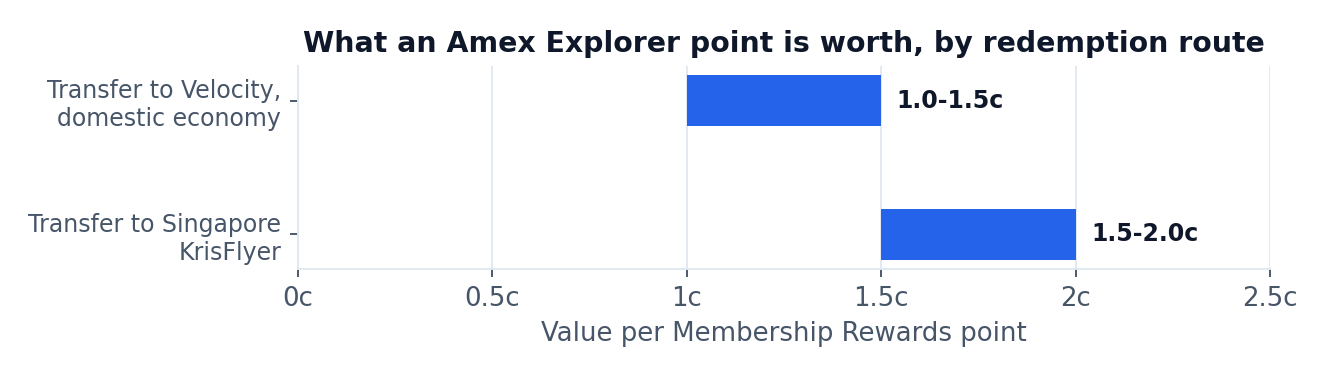
I’ve seen too many guides quote a flat “1 cent per point” valuation. That’s lazy. Membership Rewards points are worth wildly different amounts depending on what you do with them.
| What I’d do with the points | Approx value per point |
|---|---|
| Transfer to Velocity → domestic economy flight | 1.0-1.5c |
| Transfer to Singapore KrisFlyer → premium cabin | 1.5-2.0c |
| Transfer to Qantas → domestic economy | 0.7-1.5c |
| Book through Amex Travel | ~0.75c |
| Woolworths or JB Hi-Fi gift cards | ~0.5c |
| Statement credit (cashback) | ~0.5c |
My take: if your plan is to redeem for gift cards or statement credits, this isn’t your card. A flat 1.5-2% cashback Visa with no annual fee will beat it. Membership Rewards earn their value when you transfer to a frequent flyer program. Velocity is the most reliable for everyday Australians flying domestically. KrisFlyer is the best if you fly long-haul in premium cabins.
When does it pay off without the travel credit?
If you genuinely don’t fly but the lounge passes and points appeal anyway, run the maths without the credit.
At 2 points per $1 valued at 1c each (a conservative Velocity transfer):
| Monthly spend | Points/year | Value | Net after $395 fee |
|---|---|---|---|
| $1,000/month | 24,000 | $240 | −$155 |
| $1,650/month | 39,600 | $396 | +$1 |
| $2,000/month | 48,000 | $480 | +$85 |
| $3,000/month | 72,000 | $720 | +$325 |
Below $1,650/month in eligible spend, the card loses money on points alone. Above $2,000/month, it stacks up clearly.
Add the travel credit back in and the break-even drops to roughly $0/month - the card pays for itself before you’ve spent a dollar on it.
The foreign currency fee
Amex charges a currency conversion fee of around 3% on foreign-currency transactions (check the current PDS for the exact figure - Amex adjusts fees from time to time). If you shop on overseas websites or travel internationally, that’s roughly $30 on every $1,000 of foreign-currency spend.
For most Australian household budgets, that’s negligible. For anyone buying a lot from US retailers or travelling overseas multiple times a year, it’s a real cost - and there are travel-money options (Wise, Revolut, ING Orange Everyday) that don’t charge an FX fee at all. My rule: don’t use the Explorer for foreign-currency spending. Use it at home, and use a no-FX-fee card abroad.
Get this card if…
- You’ll book at least one flight, hotel, or car hire through Amex Travel this year
- You spend $2,000+/month on eligible purchases
- You want flexible points that transfer to multiple frequent flyer programs
- You value the embedded benefits (travel insurance, screen cover, purchase protection)
Don’t get this card if…
- You carry a balance month-to-month - 23.99% interest will erase every point you earn
- You won’t use the travel credit (it’s the whole reason the card works)
- Your spending is mostly government services - earn rate drops to 0.5x there
- Amex acceptance is limited where you shop (small retailers, some servos and independent cafes)
- You shop heavily on overseas websites - the FX fee makes it a poor international card
How it stacks up against the obvious alternatives
| Card | Annual fee | Earn rate | Why you’d pick it instead |
|---|---|---|---|
| Amex Explorer | $395 | 2 MR pts/$1 | Travel credit covers the fee |
| Amex Qantas Ultimate | $450 | 1.25 Qantas pts/$1 | If you only ever want Qantas points |
| ANZ Rewards Black | $375 | 2 ANZ pts/$1 (to $5k/statement, then 1) | Everyday Rewards conversion for Woolworths shoppers |
| Qantas Premier Platinum | $399 | 1 Qantas pt/$1 (to $10k/statement) | Qantas Visa with lounge passes |
| Amex Platinum | $1,450 | 2.25 MR pts/$1 | If you fly a lot and want full lounge access |
For most people who spend $2k-$5k a month and travel domestically a few times a year, the Explorer is the sweet spot. The Platinum is overkill unless you’ll use unlimited lounge access. The Ultimate and Premier Platinum lock you into Qantas. The ANZ is cheaper but its points are worth less per point.
The one question that decides it
Will I book at least one flight, hotel, or car hire through Amex Travel this year?
Yes → get the card. The travel credit makes it effectively free, and the points are upside.
No → skip it. Pick a no-fee cashback card or a cheaper Qantas-earning card. Without the credit, the Explorer doesn’t make sense.
Ready to apply?
➡️ Apply for the Amex Explorer (current offer) → (affiliate link - I earn a commission if your application is approved)
FAQ
Is the Amex Explorer card hard to get approved for?
Amex wants a minimum income (typically $40,000+) and a clean credit history. It’s mid-tier - easier than the Platinum, harder than basic cashback cards. If you’ve been declined for premium cards before, the Explorer is more accessible.
Can I use the $400 travel credit for Qantas flights?
Yes - as long as you book through the Amex Travel portal or the Amex app. Booking direct on qantas.com won’t trigger the credit.
How does the lounge access work?
Two complimentary visits per year at eligible Amex lounges. Not unlimited - that’s the Platinum. Two visits roughly covers a return trip if you arrive early.
What changed with Membership Rewards transfers in late 2025?
There was a transfer ratio adjustment for some airline partners in December 2025. A few premium-cabin redemptions now cost more points than they used to. The 2-points-per-$1 earn rate didn’t change, but the value per point dropped slightly for those specific redemptions. Velocity transfers have held up best.
Is the Amex Explorer better than the Amex Platinum?
For most people, yes. The Platinum is $1,450/year and only makes sense if you’ll use unlimited lounge access and the larger travel credits. The Explorer delivers most of the practical value at $395.
What if Amex Travel doesn’t have the flight I want?
The credit only triggers on Amex Travel bookings. In practice they cover all major Australian and international routes, but check before you assume the credit will work for a specific itinerary.
← All guides | Next: Best rewards card if you don’t fly business class → | Related: Best credit card for Woolworths →
This article is general information only. Credit cards are financial products - consider whether this product suits your personal circumstances and read the product disclosure statement before applying. Interest rates, fees and terms are accurate at time of publishing and subject to change. I earn a commission if you apply via the affiliate links on this page.
{
“@context”: “https://schema.org”,
“@type”: “FAQPage”,
“url”: “https://worthitcards.com.au/is-amex-explorer-worth-it/”,
“mainEntity”: [
{
“@type”: “Question”,
“name”: “Is the Amex Explorer card hard to get approved for?”,
“acceptedAnswer”: {
“@type”: “Answer”,
“text”: “Amex wants a minimum income (typically $40,000+) and a clean credit history. It’s mid-tier - easier than the Platinum, harder than basic cashback cards. If you’ve been declined for premium cards before, the Explorer is more accessible.”
}
},
{
“@type”: “Question”,
“name”: “Can I use the $400 travel credit for Qantas flights?”,
“acceptedAnswer”: {
“@type”: “Answer”,
“text”: “Yes - as long as you book through the Amex Travel portal or the Amex app. Booking direct on qantas.com won’t trigger the credit.”
}
},
{
“@type”: “Question”,
“name”: “How does the lounge access work?”,
“acceptedAnswer”: {
“@type”: “Answer”,
“text”: “Two complimentary visits per year at eligible Amex lounges. Not unlimited - that’s the Platinum. Two visits roughly covers a return trip if you arrive early.”
}
},
{
“@type”: “Question”,
“name”: “What changed with Membership Rewards transfers in late 2025?”,
“acceptedAnswer”: {
“@type”: “Answer”,
“text”: “There was a transfer ratio adjustment for some airline partners in December 2025. A few premium-cabin redemptions now cost more points than they used to. The 2-points-per-$1 earn rate didn’t change, but the value per point dropped slightly for those specific redemptions. Velocity transfers have held up best.”
}
},
{
“@type”: “Question”,
“name”: “Is the Amex Explorer better than the Amex Platinum?”,
“acceptedAnswer”: {
“@type”: “Answer”,
“text”: “For most people, yes. The Platinum is $1,450/year and only makes sense if you’ll use unlimited lounge access and the larger travel credits. The Explorer delivers most of the practical value at $395.”
}
},
{
“@type”: “Question”,
“name”: “What if Amex Travel doesn’t have the flight I want?”,
“acceptedAnswer”: {
“@type”: “Answer”,
“text”: “The credit only triggers on Amex Travel bookings. In practice they cover all major Australian and international routes, but check before you assume the credit will work for a specific itinerary.”
}
}
]
}
Related guides & tools