Verdict up front: Making an ATO payment by credit card purely to farm points is a break-even hobby at best, because most Australian rewards cards slash or kill their earn rate on government payments. But there is one genuinely good reason to do it: smashing out a sign-up bonus minimum spend in a single transaction. A $4,000 tax bill can unlock a bonus worth $400 to $900 for a card fee of under $20. That trade is excellent. Everything else needs a calculator and a cold shower first.
Last updated: June 2026 | [Affiliate disclosure: I earn a commission if you apply via my links - it never affects what I recommend.]
Yes, the ATO takes credit cards - for a fee
First things first, because half the people searching “ato payment by credit card” just want to know if it’s allowed. It is. The ATO accepts Visa, Mastercard and American Express through its online payment system, and it charges a card payment fee for the privilege.
Per the ATO’s current card payment fee schedule - check before paying, because these do move - the fees are:
- Visa and Mastercard (debit and credit): 0.42%
- American Express: 1.45%
So a $10,000 tax bill costs you $42 extra on a Visa or Mastercard, or $145 on an Amex. That’s the entry price. The question is whether the points you earn on the other side are worth more than that.
My take: 0.42% is honestly cheap as card surcharges go. Your local cafe probably charges you more on a flat white. The fee isn’t the problem here. The problem is what’s coming in the next section.
The catch: most cards earn rubbish on government payments
Here’s the bit the “free flights from your tax bill” crowd conveniently skips. Australian card issuers worked out years ago that people were running huge ATO payments through rewards cards, and they responded by carving out “government” as a special spend category that earns reduced points - or nothing at all.
Two verified examples from cards I’ve reviewed on this site:
- Qantas Premier Platinum earns 0.5 Qantas points per $1 on government spend, versus its normal earn rate on everyday purchases
- Amex Explorer earns 0.5 Membership Rewards points per $1 on government spend
And plenty of cards earn zero on ATO payments full stop. Before you even think about trying this, pull up your card’s earn table (it’s in the rewards terms, usually under “excluded transactions” or a tiered earn schedule) and search for the word “government”. If it’s not listed, ring the issuer and ask. Do not assume.
My take: This single fact kills about 90% of the daydream. People imagine earning 1 to 1.25 points per dollar on a $30,000 tax bill. The reality for most cards is half that, or nothing, and the maths changes completely.
The honest maths on a $10,000 tax bill
Let’s run the numbers properly, using a card that earns 0.5 points per $1 on government spend - which is about as good as it commonly gets.
| Scenario | Card fee | Points earned | Points value* | Net result |
|---|---|---|---|---|
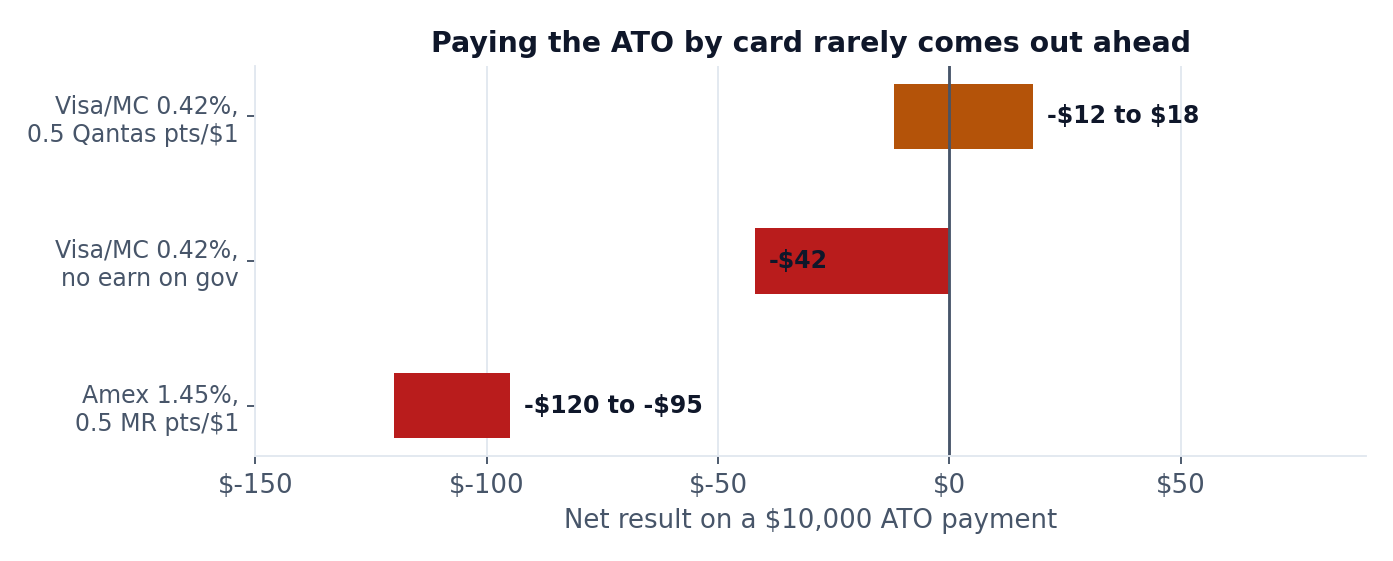
| Visa/MC at 0.42%, 0.5 Qantas pts/$1 | $42 | 5,000 Qantas | $30 - $60 | -$12 to +$18 |
| Visa/MC at 0.42%, zero gov earn | $42 | 0 | $0 | -$42 |
| Amex at 1.45%, 0.5 MR pts/$1 | $145 | 5,000 MR | $25 - $50 | -$95 to -$120 |
*Valuing Qantas points at 0.6 to 1.2 cents each depending on how you redeem (classic reward business seats at the top end, toasters at the bottom). MR points similar or slightly lower before transfer.
Read that table again. The best case - a Visa or Mastercard that actually earns on government spend, redeemed brilliantly - makes you about $18 on a ten grand tax bill. The Amex case loses you a hundred bucks minimum. That’s not a points strategy, that’s a donation.
My take: Paying the ATO for ongoing points earn is roughly break-even at best, and most people redeeming points at average value will quietly lose money. If that’s the whole plan, just pay by BPAY and buy yourself lunch with the $42.
The real play: sign-up bonus minimum spend
Now for the version of this that actually works, and works well.
Most big sign-up bonuses come with a minimum spend requirement - typically “spend $3,000 to $6,000 in the first 3 months”. For normal humans that means months of putting groceries and petrol on the card and nervously checking the tracker. A tax bill demolishes it in one hit.
Say you’ve just picked up a card with 80,000 bonus Qantas points for spending $4,000 in 90 days. You’ve got a $4,000 ATO bill due anyway. Pay it by Visa or Mastercard:
- Card fee: about $17
- Minimum spend: done, instantly
- Bonus unlocked: 80,000 points, worth roughly $480 to $960 depending on redemption
Even on a bigger $6,000 requirement the fee is around $25, and Amex at 1.45% on $4,000 is $58 - still trivial against a bonus worth many hundreds. This is the one scenario where paying tax with credit card points chasing makes unambiguous sense: the bonus dwarfs the fee by a factor of ten or more, and it usually doesn’t matter that the transaction itself earns reduced points, because ATO payments generally still count toward minimum spend (check the card’s bonus terms - a few issuers exclude government payments from qualifying spend, so verify before you commit).
My take: This is the centrepiece. I wouldn’t pay the ATO by card for drip-feed points earn, but I absolutely would to trigger a sign-up bonus. If you’ve got a tax bill coming and you’ve been eyeing a points card anyway, sequence it: apply for the card first, then pay the bill once approved.
Two other situations worth knowing about
Cards that earn full points on government spend. They exist, but they’re rare and the goalposts move. If you find one, the maths flips properly positive at 0.42%. Check the earn table, don’t trust a forum post from 2023.
Cash flow timing. Paying by card just before a due date buys you the card’s interest-free days, which can be genuinely useful for business owners juggling BAS, super and payroll in the same fortnight. The giant flashing warning: this only works if you clear the statement in full. Carry that balance at 20%+ interest and one month of charges incinerates every point you’ve ever earned. Cards are a terrible place to park tax debt - if you genuinely can’t pay, talk to the ATO about a payment plan instead, their rates are far kinder.
A quick word on third-party payment services like pay.com.au and Sniip, which route your ATO payment in ways that can change what your card earns. They’re real, plenty of points nerds use them, and they charge their own fees on top. I’m deliberately not quoting their rates because they change often - run the maths on the total fee versus the actual earn before assuming they win. Also note these are third-party channels, so how your card treats the transaction may differ from paying the ATO directly.
The one question that decides it
Am I doing this to unlock a sign-up bonus, or just to earn points on the payment itself?
If it’s a sign-up bonus: go for it. The fee is small, the bonus is large, and a tax bill is the easiest minimum spend you’ll ever hit. Just confirm ATO payments count as qualifying spend for that specific card.
If it’s just ongoing earn: almost certainly don’t bother. At 0.5 points per dollar you’re fighting for break-even, and on Amex you’re definitively behind. Pay by BPAY and move on with your life.
FAQ
How much does the ATO charge for credit card payments?
Per the ATO’s current card payment fee schedule, 0.42% for Visa and Mastercard (both debit and credit) and 1.45% for American Express. On a $10,000 bill that’s $42 or $145 respectively. Check the schedule before paying as fees can change.
Do I earn points when I pay the ATO by credit card?
Sometimes, but usually at a reduced rate. Many Australian rewards cards earn half points or zero on government payments - Qantas Premier Platinum and Amex Explorer both earn 0.5 points per $1 on government spend, and plenty of cards earn nothing. Check your card’s earn table for “government” before paying.
Is the ATO card payment fee tax deductible?
It may be deductible for business taxpayers in specific circumstances, but it depends on your situation - ask your accountant. This article is general information, not tax advice.
Does paying the ATO by credit card count as a cash advance?
No - payments through the ATO’s official online card system process as purchases, not cash advances, so you keep your interest-free days and avoid cash advance rates. That’s confirmed for the ATO’s official payment channel; third-party bill payment services differ, so check how those process before using one.
What’s the best credit card for paying the ATO?
Honestly, it’s whichever card has a sign-up bonus you’re chasing. The ongoing earn on government spend is so weak across the board that the “best” card is the one where your tax bill knocks over a $4,000 minimum spend and unlocks a bonus worth $400 to $900.
Can I pay someone else’s tax bill with my credit card?
The ATO’s payment system asks for a payment reference number, not the cardholder’s identity, so paying a family member’s or your company’s bill from your personal card is generally possible. Check the card issuer’s terms and your bonus’s qualifying spend rules before relying on it.
← All guides | Best Qantas points credit cards → | Hub: best rewards card if you don’t fly business class →
This article is general information only, not tax advice. Credit cards are financial products - consider whether each product suits your personal circumstances and read the product disclosure statement before applying. ATO fees and card earn rates are accurate at time of publishing and subject to change. I earn a commission if you apply via the affiliate links on this page.
{
“@context”: “https://schema.org”,
“@type”: “FAQPage”,
“url”: “https://worthitcards.com.au/paying-ato-credit-card-points/”,
“mainEntity”: [
{
“@type”: “Question”,
“name”: “How much does the ATO charge for credit card payments?”,
“acceptedAnswer”: {
“@type”: “Answer”,
“text”: “Per the ATO’s current card payment fee schedule, 0.42% for Visa and Mastercard (both debit and credit) and 1.45% for American Express. On a $10,000 bill that’s $42 or $145 respectively. Check the schedule before paying as fees can change.”
}
},
{
“@type”: “Question”,
“name”: “Do I earn points when I pay the ATO by credit card?”,
“acceptedAnswer”: {
“@type”: “Answer”,
“text”: “Sometimes, but usually at a reduced rate. Many Australian rewards cards earn half points or zero on government payments - Qantas Premier Platinum and Amex Explorer both earn 0.5 points per $1 on government spend, and plenty of cards earn nothing. Check your card’s earn table for “government” before paying.”
}
},
{
“@type”: “Question”,
“name”: “Is the ATO card payment fee tax deductible?”,
“acceptedAnswer”: {
“@type”: “Answer”,
“text”: “It may be deductible for business taxpayers in specific circumstances, but it depends on your situation - ask your accountant. This article is general information, not tax advice.”
}
},
{
“@type”: “Question”,
“name”: “Does paying the ATO by credit card count as a cash advance?”,
“acceptedAnswer”: {
“@type”: “Answer”,
“text”: “No - payments through the ATO’s official online card system process as purchases, not cash advances, so you keep your interest-free days and avoid cash advance rates. That’s confirmed for the ATO’s official payment channel; third-party bill payment services differ, so check how those process before using one.”
}
},
{
“@type”: “Question”,
“name”: “What’s the best credit card for paying the ATO?”,
“acceptedAnswer”: {
“@type”: “Answer”,
“text”: “Honestly, it’s whichever card has a sign-up bonus you’re chasing. The ongoing earn on government spend is so weak across the board that the “best” card is the one where your tax bill knocks over a $4,000 minimum spend and unlocks a bonus worth $400 to $900.”
}
},
{
“@type”: “Question”,
“name”: “Can I pay someone else’s tax bill with my credit card?”,
“acceptedAnswer”: {
“@type”: “Answer”,
“text”: “The ATO’s payment system asks for a payment reference number, not the cardholder’s identity, so paying a family member’s or your company’s bill from your personal card is generally possible. Check the card issuer’s terms and your bonus’s qualifying spend rules before relying on it.”
}
}
]
}
Related guides & tools