Verdict up front: If your retailers take Amex and you’ll book one Qantas flight a year, the Amex Qantas Ultimate ($450/year) is the best Qantas card in Australia - its $450 annual Qantas Travel Credit effectively cancels the fee, and the 1.25 points per $1 uncapped earn is the highest going. If you want a Visa, the Qantas Premier Platinum ($399) is now the value pick - cheaper than the NAB Qantas Signature ($420) with double its full-earn threshold. On a budget, the Qantas Premier Everyday ($49 first year, then $99) is the cheapest way in. Most “best Qantas card” guides ranking above this one still quote 2024 fees - the order changed.
Last updated: June 2026 | [Affiliate disclosure: I earn a commission if you apply via my links - it never affects which cards I recommend.]
Every bank wants to sell you a Qantas card, and every comparison site lists thirty of them sorted by who pays the biggest commission. Here’s the version for people who fly economy a few times a year and just want the most points back on their spending.
I’ve verified every fee and earn rate on this page against the issuer’s current product pages this month. That matters more than usual right now, because two of the most-recommended cards repriced and most guides haven’t noticed.
The shortlist, ranked
1. Amex Qantas Ultimate - best overall (if Amex works for you)
- Annual fee: $450
- Earn rate: 1.25 Qantas Points per $1, uncapped · 2 points per $1 on eligible Qantas spend · 0.5 points per $1 on government spend
- The killer feature: $450 annual Qantas Travel Credit, booked via Amex Travel on eligible Qantas flights
- Who it’s for: Anyone who books at least one Qantas flight a year and shops mostly where Amex is accepted
The maths most guides bury: $450 fee minus $450 travel credit = the card costs you nothing in a year where you book one eligible Qantas flight you were going to book anyway. Everything it earns after that - and at 1.25 points per $1 uncapped, it out-earns every Visa on this list - is pure upside.
The catch I want to be upfront about: Amex acceptance. Major supermarkets, big retailers and most online stores take it; small cafes, independent servos and some bills don’t. If a meaningful slice of your spend can’t go on Amex, the effective earn rate drops and the Visa options below close the gap. Pair it with a no-fee Visa for the gaps.
➡️ Check the current Amex Qantas Ultimate offer → (affiliate link)
2. Qantas Premier Platinum - best Qantas Visa
- Annual fee: $399
- Earn rate: 1 Qantas Point per $1 up to $10,000 per statement period, then 0.5 · bonus earn on Qantas spend
- Extras: 2 Qantas Club lounge passes per year (conditions apply)
- Who it’s for: Spenders of $2,500+/month who want broad Visa acceptance
The Premier Platinum quietly became the cheapest of the big-bank-tier Qantas Visas, and it holds full earn to $10,000 a month - a threshold the NAB halves. The lounge passes are worth up to $160 if you genuinely use them. Full break-even tables in the detailed review.
➡️ Apply for the Qantas Premier Platinum → (affiliate link)
3. Qantas Premier Everyday - best on a budget
- Annual fee: $49 in the first year, then $99
- Earn rate: 0.75 Qantas Points per $1 up to $3,000 per statement period, then 0.4 · 1 point per $1 on international spend
- Who it’s for: Spenders under $2,000/month who want Qantas Points without a $400 fee
The honest budget option. The earn rate is modest and the $3,000 full-rate band is tight, but at $49-$99 the bar it has to clear is low. At $2,000/month you earn roughly 23,000 points a year - about $140-$280 of flight value against a $99 fee.
My take: this beats paying $399+ for a premium card you can’t feed enough spend. It does not beat a no-fee card plus the free Everyday Rewards-to-Qantas pipeline if your spend is genuinely small - run both numbers.
➡️ Apply for the Qantas Premier Everyday → (affiliate link)
4. ANZ Frequent Flyer Black - the alternative Visa
- Annual fee: $425
- Earn rate: 1 Qantas Point per $1 up to $7,500 per statement period, then 0.5
- Who it’s for: ANZ customers, or anyone chasing its sign-up bonus when it spikes
Sits between the Premier Platinum and the NAB on both fee and threshold. Its sign-up bonuses periodically spike above the field - when they do, it’s worth a Year 1 play. As an ongoing hold, the Premier Platinum does the same job for $26 less.
➡️ Check the current ANZ Frequent Flyer Black offer → (affiliate link)
5. NAB Qantas Rewards Signature - only on a promo
- Annual fee: $420
- Earn rate: 1 Qantas Point per $1 up to $5,000 per statement period, then 0.5 to $20,000
- Who it’s for: NAB loyalists, or bonus-chasers in a first-year-discount window
This used to be the budget pick at $295. At $420 it costs more than the Premier Platinum and halves your earn rate at half the spend. The full review explains why the old advice has expired. Get it only when a first-year discount or outsized bonus is running.
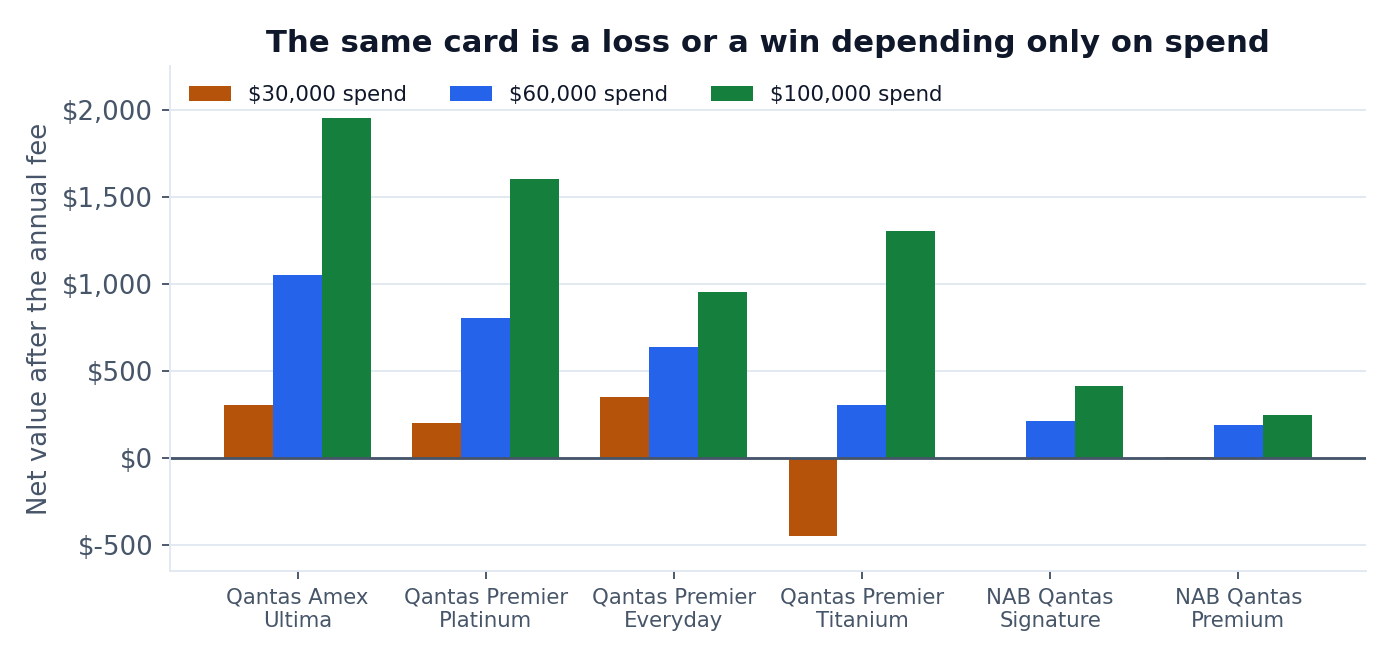
Side by side
| Card | Annual fee | Earn/$1 | Full rate to | Travel credit | Lounge passes |
|---|---|---|---|---|---|
| Amex Qantas Ultimate | $450 | 1.25 (uncapped) | No cap | $450/yr | No |
| Qantas Premier Platinum | $399 | 1.0 | $10,000/statement | No | 2/yr |
| Qantas Premier Everyday | $49 yr 1, $99 | 0.75 | $3,000/statement | No | No |
| ANZ Frequent Flyer Black | $425 | 1.0 | $7,500/statement | No | No |
| NAB Qantas Signature | $420 | 1.0 | $5,000/statement | No | No |
The maths: 12 months at $3,500/month of card spend
Points valued at 1.2c (a fair domestic-economy redemption). Travel credit counted only if you’d book the flight anyway.
| Card | Points/year | Points value | Fee (net of credit) | Net result |
|---|---|---|---|---|
| Amex Qantas Ultimate | 52,500 | $630 | $0 ($450 - $450) | +$630 |
| Qantas Premier Platinum | 42,000 | $504 | $399 | +$105 (+$265 with both lounge passes) |
| ANZ Frequent Flyer Black | 42,000 | $504 | $425 | +$79 |
| NAB Qantas Signature | 42,000 | $504 | $420 | +$84 |
| Qantas Premier Everyday | 29,400 | $353 | $99 | +$254 |
My take on this table: the Ultimate wins by a street IF the travel credit is genuinely useful to you and your spend can live on Amex. The surprise second place is the cheap Premier Everyday - low fees forgive a lot. The three $400-ish Visas bunch together; among them, buy the Premier Platinum’s lounge passes and lower fee, not the NAB’s branding.
And if you redeem points for gift cards instead of flights, halve every points value above - at which point no card on this list beats a simple no-fee setup. Flights or don’t bother. See how much Qantas Points are actually worth - or plug your own numbers into the Qantas Points Calculator.
Don’t get any Qantas card if…
- You carry a balance. Interest at 20%+ erases every point many times over. Pay in full or get a low-rate card instead.
- You spend under $2,000/month. Use the free pipeline instead: scan Everyday Rewards at Woolworths, convert at 2,000 ER points to 1,000 Qantas Points, pay with a no-fee card. Slow, but free. Details in how to earn Qantas Points.
- You fly Virgin. You want Velocity-earning cards - and possibly a different strategy entirely; see Velocity vs Qantas Points.
- You’d redeem for gift cards. That’s ~0.6c per point. A simpler rewards setup wins; start at the non-traveller hub.
The one question that decides it
Will you book at least one Qantas flight this year, and does your spending mostly happen where Amex is accepted?
Yes to both → Amex Qantas Ultimate. The travel credit makes it effectively free and nothing out-earns it.
Yes flight, no Amex → Qantas Premier Platinum.
Not sure you’ll fly at all → Qantas Premier Everyday at most, or skip the category.
FAQ
What is the best credit card for earning Qantas Points in Australia?
The Amex Qantas Ultimate earns the most (1.25 points per $1, uncapped) and its $450 annual Qantas Travel Credit offsets the $450 fee for anyone who books one eligible Qantas flight a year. The best Visa alternative is the Qantas Premier Platinum at $399.
Which Qantas credit card has the lowest annual fee?
The Qantas Premier Everyday: $49 in the first year, then $99. It earns 0.75 points per $1 on the first $3,000 per statement period. It suits spenders under about $2,000/month who still want to build a Qantas balance.
Do these cards earn points on every purchase?
Mostly, with two standard carve-outs: government payments (ATO, council rates) earn reduced points or none, and earn rates taper above each card’s monthly threshold - $10,000 on the Premier Platinum, $7,500 on the ANZ, $5,000 on the NAB. The Amex Ultimate has no everyday cap.
How many Qantas Points do I need for a flight?
Sydney-Melbourne return in economy is typically 16,000-20,000 points plus taxes. East coast to Perth return runs 24,000-30,000. A single decent sign-up bonus covers several domestic returns - which is why the bonus matters more than the earn rate in Year 1.
Are Qantas credit card points the same as flying points?
Yes - they land in the same Qantas Frequent Flyer account whether earned on the ground or in the air. Card earn also counts as account activity, which keeps your balance from expiring. See do Qantas Points expire.
Is a Qantas card better than a flexible points card?
If you only ever redeem on Qantas, direct-earn is simpler. A flexible card (like the Amex Explorer earning Membership Rewards) earns points you can later send to Qantas, Velocity or KrisFlyer - more flexibility, slightly more thinking. The Amex Explorer review covers the trade-off.
← All guides | Qantas Premier Platinum review → | NAB Qantas Signature review → | How to earn Qantas Points → | Qantas Points Calculator →
This article is general information only. Credit cards are financial products - consider whether each product suits your personal circumstances and read the product disclosure statement before applying. Interest rates, fees, sign-up offers and reward seat availability are accurate at time of publishing and subject to change. I earn a commission if you apply via the affiliate links on this page.
{
“@context”: “https://schema.org”,
“@type”: “FAQPage”,
“url”: “https://worthitcards.com.au/best-qantas-points-credit-cards/”,
“mainEntity”: [
{
“@type”: “Question”,
“name”: “What is the best credit card for earning Qantas Points in Australia?”,
“acceptedAnswer”: {
“@type”: “Answer”,
“text”: “The Amex Qantas Ultimate earns the most (1.25 points per $1, uncapped) and its $450 annual Qantas Travel Credit offsets the $450 fee for anyone who books one eligible Qantas flight a year. The best Visa alternative is the Qantas Premier Platinum at $399.”
}
},
{
“@type”: “Question”,
“name”: “Which Qantas credit card has the lowest annual fee?”,
“acceptedAnswer”: {
“@type”: “Answer”,
“text”: “The Qantas Premier Everyday: $49 in the first year, then $99. It earns 0.75 points per $1 on the first $3,000 per statement period. It suits spenders under about $2,000/month who still want to build a Qantas balance.”
}
},
{
“@type”: “Question”,
“name”: “Do these cards earn points on every purchase?”,
“acceptedAnswer”: {
“@type”: “Answer”,
“text”: “Mostly, with two standard carve-outs: government payments (ATO, council rates) earn reduced points or none, and earn rates taper above each card’s monthly threshold - $10,000 on the Premier Platinum, $7,500 on the ANZ, $5,000 on the NAB. The Amex Ultimate has no everyday cap.”
}
},
{
“@type”: “Question”,
“name”: “How many Qantas Points do I need for a flight?”,
“acceptedAnswer”: {
“@type”: “Answer”,
“text”: “Sydney-Melbourne return in economy is typically 16,000-20,000 points plus taxes. East coast to Perth return runs 24,000-30,000. A single decent sign-up bonus covers several domestic returns - which is why the bonus matters more than the earn rate in Year 1.”
}
},
{
“@type”: “Question”,
“name”: “Are Qantas credit card points the same as flying points?”,
“acceptedAnswer”: {
“@type”: “Answer”,
“text”: “Yes - they land in the same Qantas Frequent Flyer account whether earned on the ground or in the air. Card earn also counts as account activity, which keeps your balance from expiring. See do Qantas Points expire.”
}
},
{
“@type”: “Question”,
“name”: “Is a Qantas card better than a flexible points card?”,
“acceptedAnswer”: {
“@type”: “Answer”,
“text”: “If you only ever redeem on Qantas, direct-earn is simpler. A flexible card (like the Amex Explorer earning Membership Rewards) earns points you can later send to Qantas, Velocity or KrisFlyer - more flexibility, slightly more thinking. The Amex Explorer review covers the trade-off.”
}
}
]
}
Related guides & tools