Every card review on this site ends with “the one question that decides it”. This calculator runs that question on your actual numbers: enter your monthly spending and it ranks the cards we’ve reviewed by net annual value - annual fee subtracted, earn caps and tapers modelled per statement period (the part the banks’ marketing tables skip).
The figures use each card’s verified June 2026 fees and earn rates. The value range reflects how you redeem: gift cards at the low end, well-redeemed flights at the high end - see what points are actually worth. For the written rankings, start at the best rewards card hub.
Common questions
How do I know if a card’s annual fee is worth paying?
Work out the dollar value of the points you would realistically earn in a year, then subtract the annual fee. If the result is positive, the card pays for itself. This calculator does that maths for you, including earn caps.
Why do earn caps matter?
Many Australian cards reduce or stop earning points above a monthly spend cap, so the headline earn rate overstates what most people actually get. The calculator models the cap, not the headline rate.
The only question a rewards card has to answer
A rewards card is a trade: you pay a known annual fee for an unknown amount of points. It is worth it when the points you will actually earn, valued at what you will actually redeem them for, exceed the fee. Everything else - the sign-up bonus, the lounge passes, the branding - is decoration on that one calculation.
Written out:
(annual spend x earn rate x point value) - annual fee = net annual value
If that number is negative, the card costs you money no matter how good the marketing is. The calculator above runs it across every card reviewed on this site using your monthly spend, and it models the parts most people forget: earn caps, tapered rates above a threshold, and categories that earn at a lower rate than the headline.
A worked example
Someone spending $3,000 a month - $36,000 a year - on a card earning 1 point per dollar, with points they redeem at about 1.5c each, earns roughly $540 of value a year. A $195 annual fee leaves about $345 net. That card is comfortably worth it.
Drop the spend to $1,000 a month and the same card earns about $180 of value against the same $195 fee. Now it is slightly negative, and a no-annual-fee card wins.
The card did not change. The spend did. This is why “best card” lists without a spend figure attached are close to meaningless.
The break-even spend
The more useful way to read the output is backwards. Rearranged, the fee tells you the minimum spend that justifies it:
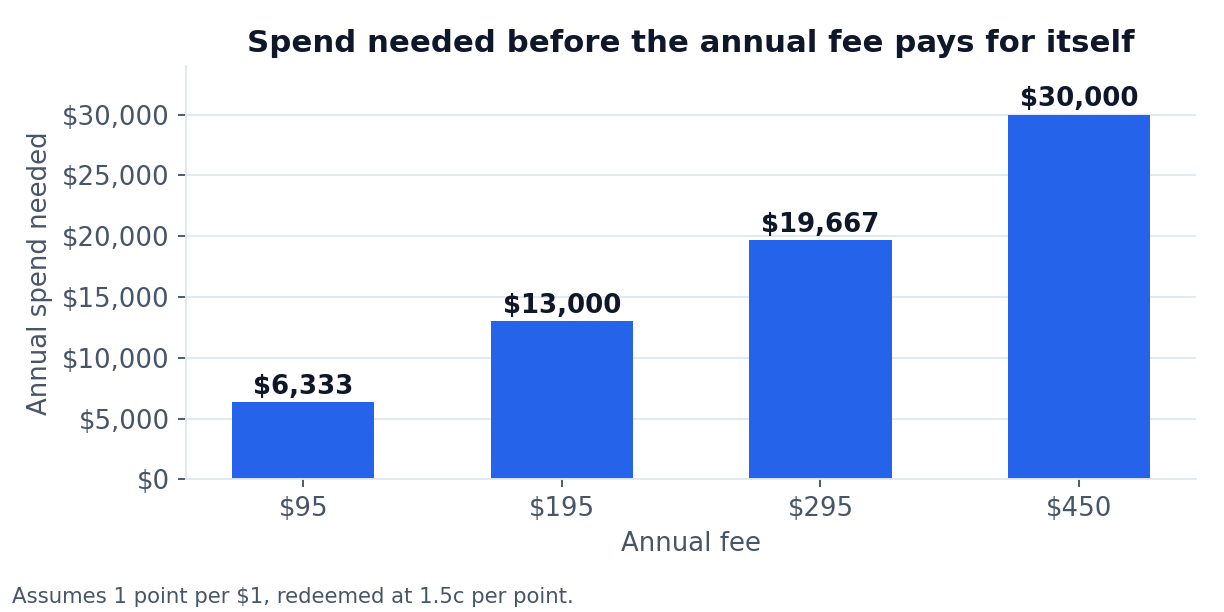
annual fee / (earn rate x point value) = break-even annual spend
A $195 fee on a card earning 1 point per dollar at 1.5c per point needs $13,000 of annual spend before it breaks even. If you spend less than that, you are subsidising the card. Knowing your break-even number makes every card review on this site readable in about ten seconds.
When the answer changes
- If you redeem for gift cards. Point value drops to around half a cent, which roughly triples the break-even spend. Many cards that look worthwhile stop being so.
- If your biggest merchants do not take the card. An Amex earning a great rate is earning nothing at ALDI or Costco. Model the spend that actually lands on the card.
- Year one versus ongoing. A waived first-year fee plus a sign-up bonus can make almost any card look brilliant for twelve months. Judge it on year two.
- If you carry a balance. Interest at 20%-plus dwarfs any rewards rate. If you revolve a balance, the right card is the cheapest one, not the most rewarding - see the balance transfer calculator.
Common questions
What point value should I use?
Use what you actually redeem for, not the best case. If you take gift cards, use the gift card rate. The Qantas and Velocity calculators will give you your real number.
Should I include the sign-up bonus?
Keep it separate. A bonus is a one-off; the fee is annual. A card that only wins because of year-one perks is a card to cancel before the second fee hits.
Is a no-annual-fee card always safer?
Safer, but not always better. Above the break-even spend, a fee-paying card with a higher earn rate genuinely wins. Below it, the free card wins. See the best no annual fee credit cards.
What if the numbers say no rewards card at all?
Then that is the answer, and it is the right one for a lot of people. The which card quiz will tell you so directly.