Verdict up front: The longest 0% balance transfer offers in mid-2026 run to 26 months (ANZ Low Rate, with a 3% transfer fee) and around 28 months at the very top of the market. But the longest offer is not automatically the best one: a 3% fee on $10,000 is $300 up front, and if you can clear the debt in 12-15 months, a shorter offer with a 1-2% fee usually wins. Pick the offer by how many months YOU need, divide your balance by that number, set that as an automatic repayment, and do not spend a cent on the new card. That last sentence is the whole game.
Last updated: June 2026 | [Affiliate disclosure: I earn a commission if you apply via my links - it never affects what I recommend. If you’re in financial difficulty, talk to the National Debt Helpline on 1800 007 007 before taking on new credit - it’s free.]
A balance transfer is the one credit card product where the banks’ interests and yours genuinely point in opposite directions. They’re betting you won’t clear the balance before the 0% period ends; you’re betting you will. Roughly half of balance transferrers lose that bet - which is exactly why the offers exist.
This page is the version of the comparison that’s honest about the traps. If you’re new to the concept, start with what a balance transfer actually is and come back.
The market in mid-2026, at a glance
I’m deliberately not listing thirty cards. The market clusters into three bands, and the right move is picking your band first:
| Band | 0% period | Typical transfer fee | Who it suits |
|---|---|---|---|
| Long | 24-28 months | 2-3% (3% most common) | Larger balances ($8,000+) needing maximum runway |
| Medium | 15-20 months | 1-3% | Most people: $4,000-$8,000 cleared at a steady pace |
| Short | 6-14 months | 0-2% (some $0 fee) | Smaller balances you can clear fast, at minimum cost |
Current reference points (verify the live offer before applying - these change monthly):
- ANZ Low Rate - 0% for 26 months, 3% transfer fee. The longest widely available big-bank offer right now.
- Bank of Melbourne Vertigo (and its St George / BankSA siblings) - 0% for 20 months, 3% fee. Reverts to the cash advance rate.
- HSBC Low Rate - 0% for 12 months, 2% fee. Reverts to a 25.99% cash advance rate - a clean example of why the revert rate matters.
- Smaller banks and credit unions periodically run $0-fee transfers on 6-12 month offers - if your balance is small, these are the cheapest exit in the market.
➡️ Compare current balance transfer offers → (affiliate link)
The maths: longest is not cheapest
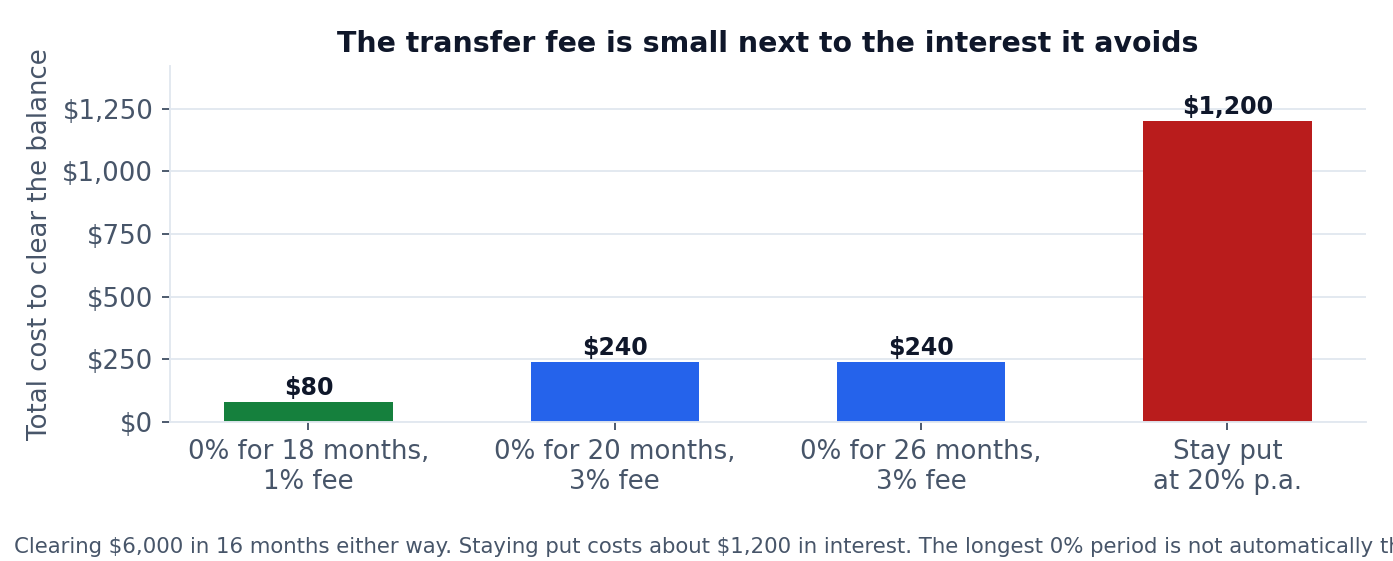
Say you owe $8,000 and can afford $500/month.
| Offer | Months you need | Transfer fee | Total cost to clear |
|---|---|---|---|
| 0% for 26 months, 3% fee | 16 | $240 | $240 |
| 0% for 20 months, 3% fee | 16 | $240 | $240 |
| 0% for 18 months, 1% fee | 16 | $80 | $80 |
| Stay put at 20% p.a. | 18 | - | ~$1,200 in interest |
At $500/month you only need 16 months - so the 26-month headline offer buys you 10 months of runway you’ll never use, at triple the fee of the 18-month offer. The fee is the price; the months are the product. Don’t buy more months than you need.
Run your own numbers in the Balance Transfer Calculator - it tells you the months you actually need and what each fee structure costs you.
My take: if your repayment capacity is genuinely uncertain, buying extra months is fair insurance - a too-short offer that reverts at 21-26% is a worse failure than an oversized fee. But know you’re buying insurance, and price it.
The three traps (in order of damage)
1. Spending on the card
On most balance transfer cards, new purchases get no interest-free days while you carry a transferred balance - they accrue interest from day one, at the purchase rate, and on some cards your repayments are applied in ways that keep the cheap balance dying slowly while the expensive one grows. The fix is absolute: the new card never goes in your wallet. Transfer, set up the direct debit, put the card in a drawer.
2. Paying minimums
Minimum repayments are calibrated so the balance does NOT clear within the promo. On $8,000 over 26 months, minimums leave thousands reverting to the cash advance rate - typically 20-26% p.a., higher than what you escaped. The only repayment number that matters: balance ÷ promo months, automated, starting month one.
3. The revert rate
Whatever survives the promo is charged at the card’s cash advance rate (the HSBC example: 25.99%). If you’re not confident the balance dies inside the window, take a longer offer or don’t transfer at all - a personal loan at a fixed rate with a fixed end date is often the more honest product for debt that needs 3+ years.
The eligibility fine print
- You can’t transfer between cards in the same banking group. CommBank to CommBank is out; so is Westpac to St George (same group). Pick a new bank.
- Transfer limits are typically 80-95% of your new card’s credit limit - you may not get the whole balance across. Check the offer’s stated limit.
- Applications are credit-assessed on your ability to repay the full limit - recent missed payments make approval unlikely, and a declined application still lands on your credit file.
- The 0% clock starts at approval, not at your first repayment. Transfers can take days to a couple of weeks to process; the months are already ticking.
Get a balance transfer card if…
- You have a clear repayment number (balance ÷ months) and you’ve automated it
- The debt is the kind you stopped adding to - the spending that created it has been fixed
- The transfer fee is less than the interest you’d otherwise pay (the calculator answers this in ten seconds)
Don’t get one if…
- You’d keep spending on any card - the structure punishes it specifically
- You need more than ~2 years to clear the debt - compare a fixed-rate personal loan instead
- You’re juggling missed payments already - call the National Debt Helpline (1800 007 007, free) before applying for anything
The one question that decides it
What’s your balance divided by what you can truly pay monthly?
That’s the months you need. Buy the cheapest offer with at least that many months, automate the repayment, freeze the card. Everything else on every comparison site is noise.
FAQ
What is the longest 0% balance transfer offer in Australia?
As of mid-2026, the longest widely available big-bank offer is 26 months (ANZ Low Rate, 3% transfer fee), with offers around 28 months appearing at the top of the market. Offers change monthly - and longest is frequently not cheapest once the transfer fee is priced in.
Do balance transfer cards charge a fee?
Usually a one-off transfer fee of 1-3% of the amount moved, with 3% the most common. Some shorter offers (6-12 months) waive it entirely. On $10,000, the difference between a 1% and 3% fee is $200 - real money that should drive your choice between similar offers.
What happens when the 0% period ends?
Any remaining transferred balance is charged at the card’s cash advance rate - typically 20-26% p.a., often higher than the rate you escaped. This is the bank’s whole bet. Clear the balance inside the window or the transfer worked against you.
Can I make purchases on a balance transfer card?
You can, but you shouldn’t. While you carry a transferred balance, new purchases on most cards accrue interest immediately with no interest-free days. Treat the card as a repayment vehicle only - never carry it.
Can I balance transfer between two cards from the same bank?
No - banks don’t accept transfers from their own cards or cards in the same banking group (e.g. Westpac, St George, Bank of Melbourne and BankSA are one group). You’ll need to move to a different banking group.
Does a balance transfer hurt my credit score?
The application creates a credit enquiry, and a new account changes your file - a small short-term dip is normal. Clearing debt faster helps you long-term. Multiple applications in quick succession hurt more, so pick one offer and apply once.
← All guides | What is a balance transfer? → | Balance Transfer Calculator → | Hub: best rewards card if you don’t fly business class →
This article is general information only, not financial advice. Credit cards are financial products - consider whether each product suits your personal circumstances and read the product disclosure statement before applying. Offers, fees and rates are accurate at time of publishing and subject to change; verify the live offer before applying. I earn a commission if you apply via the affiliate links on this page. If you’re struggling with debt, the National Debt Helpline (1800 007 007) offers free, independent help.
{
“@context”: “https://schema.org”,
“@type”: “FAQPage”,
“url”: “https://worthitcards.com.au/balance-transfer-credit-cards-australia/”,
“mainEntity”: [
{
“@type”: “Question”,
“name”: “What is the longest 0% balance transfer offer in Australia?”,
“acceptedAnswer”: {
“@type”: “Answer”,
“text”: “As of mid-2026, the longest widely available big-bank offer is 26 months (ANZ Low Rate, 3% transfer fee), with offers around 28 months appearing at the top of the market. Offers change monthly - and longest is frequently not cheapest once the transfer fee is priced in.”
}
},
{
“@type”: “Question”,
“name”: “Do balance transfer cards charge a fee?”,
“acceptedAnswer”: {
“@type”: “Answer”,
“text”: “Usually a one-off transfer fee of 1-3% of the amount moved, with 3% the most common. Some shorter offers (6-12 months) waive it entirely. On $10,000, the difference between a 1% and 3% fee is $200 - real money that should drive your choice between similar offers.”
}
},
{
“@type”: “Question”,
“name”: “What happens when the 0% period ends?”,
“acceptedAnswer”: {
“@type”: “Answer”,
“text”: “Any remaining transferred balance is charged at the card’s cash advance rate - typically 20-26% p.a., often higher than the rate you escaped. This is the bank’s whole bet. Clear the balance inside the window or the transfer worked against you.”
}
},
{
“@type”: “Question”,
“name”: “Can I make purchases on a balance transfer card?”,
“acceptedAnswer”: {
“@type”: “Answer”,
“text”: “You can, but you shouldn’t. While you carry a transferred balance, new purchases on most cards accrue interest immediately with no interest-free days. Treat the card as a repayment vehicle only - never carry it.”
}
},
{
“@type”: “Question”,
“name”: “Can I balance transfer between two cards from the same bank?”,
“acceptedAnswer”: {
“@type”: “Answer”,
“text”: “No - banks don’t accept transfers from their own cards or cards in the same banking group (e.g. Westpac, St George, Bank of Melbourne and BankSA are one group). You’ll need to move to a different banking group.”
}
},
{
“@type”: “Question”,
“name”: “Does a balance transfer hurt my credit score?”,
“acceptedAnswer”: {
“@type”: “Answer”,
“text”: “The application creates a credit enquiry, and a new account changes your file - a small short-term dip is normal. Clearing debt faster helps you long-term. Multiple applications in quick succession hurt more, so pick one offer and apply once.”
}
}
]
}
Related guides & tools