Verdict up front: The best no-annual-fee rewards card in Australia is the Coles No Annual Fee Mastercard: 1 Flybuys point per $2, no fee ever, and points that turn into $10 off a shop at a fixed rate. It suits people spending $1,000 to $3,000 a month who clear the balance. There is no longer any $0 Amex that earns points, and above about $30,000 a year of spend a fee-charging card beats every free one.
Last updated: September 2026. Card figures verified 19 July 2026 against issuer pages and re-checked 19 September 2026; none of the three cards on this page changes on 1 October 2026. [Affiliate disclosure: I earn a commission if you apply via the credit card links on this page - it never affects my analysis.]
The short answer
A no-annual-fee rewards card is the right call if you spend modestly, want simple value, and refuse to pay for points you will not earn back. The trade is real though: $0 fee cards in Australia almost always earn at a slower rate, usually around 0.5 points per $1 or 1 point per $2, often with a monthly cap, and rarely transfer cleanly to airline programs.
Our top pick below earns the most usable points per dollar for everyday spend with no fee, ever. If your spend is higher than about $30,000 a year and you redeem for flights, skip this category and look at a fee-charging rewards card instead, because the extra earn rate will beat the fee. Our annual fee break-even register shows exactly where that line sits for every card.
A note before you apply: a rewards card only pays off if you clear the balance in full every month. Interest on these cards runs around 20% p.a., which wipes out any points value in a single late cycle.
How we picked
We ranked $0-annual-fee rewards cards on the things that actually decide your return, not the marketing:
- Net points per dollar. Earn rate multiplied by realistic point value. A “1 point per $1” card that gives you 0.5 cents per point is worth 0.5 cents per dollar. We compare on that net figure, not the headline.
- The cap. Most no-fee cards cap the full earn rate per statement period (for example, up to $5,000 per period on the top retail pick below). Spend past the cap and you earn less or nothing.
- Redemption that suits a low spender. Gift cards and statement credit beat a thin airline transfer you can never use. We favour cards whose points turn into supermarket dollars or cashback at a fixed rate.
- Card network and acceptance. Visa and Mastercard are accepted almost everywhere in Australia. Amex earns can be higher but acceptance is patchier at small fuel and grocery merchants, which matters more on a budget card.
- No fee, genuinely ongoing. Not a “fee waived in year one” trick. A true $0-forever card.
We do not count sign-up bonuses in this category. No-fee cards rarely run big ones, and a bonus is a one-off, not a reason to keep a card.
Top pick: best overall no-annual-fee rewards card
The Coles No Annual Fee Mastercard is our pick for most people who want rewards without a fee.
Best for: steady everyday spenders putting roughly $1,000 to $3,000 a month through the card and clearing it in full.
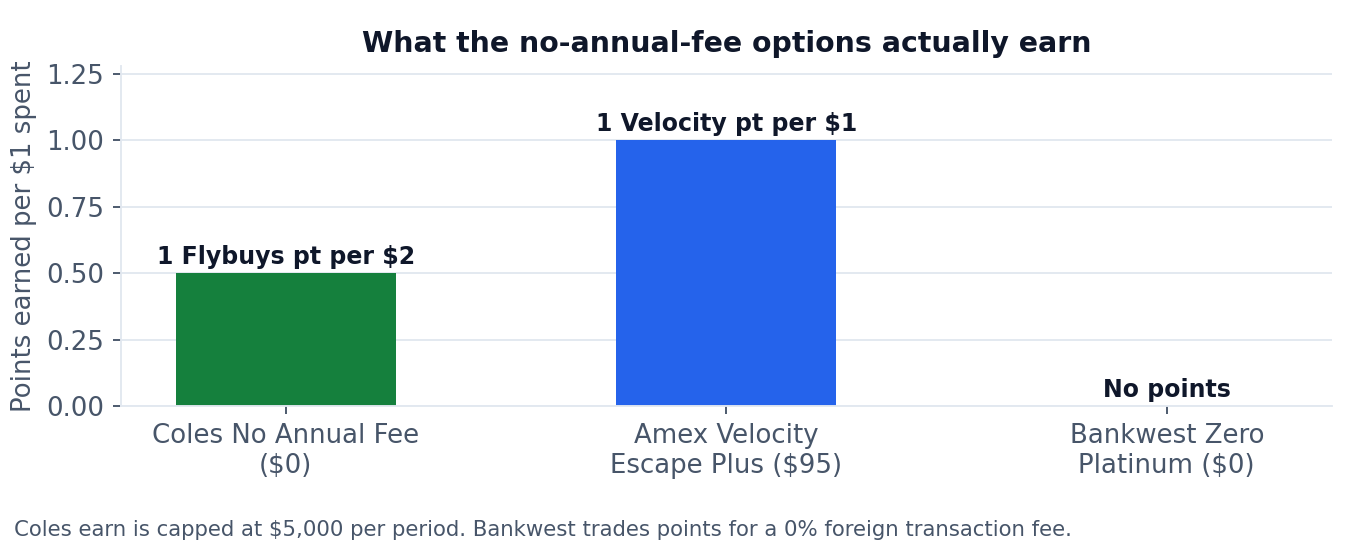
- Earns 1 Flybuys point per $2 on eligible purchases with no annual fee, ever.
- Flybuys redeem as money off a Coles shop (see our Coles and Flybuys card guide) at a fixed, predictable rate (2,000 points = $10 off, about 0.5 cents a point), so you are not gambling on award seats.
- It is a Mastercard, so you actually earn on most transactions.
The catch: the earn is capped at $5,000 per statement period - about 2,500 points a month. Spend above that earns zero points. If you regularly blow past the cap, this card leaves value on the table and a fee-charging card likely beats it.
Best for higher earn: the (almost) no-fee Amex option
An honesty note first: Amex no longer offers a $0-annual-fee card that earns points in Australia. The old free earners, the Qantas Discovery and the Velocity Escape, closed to new applicants, and the only current $0 Amex is the Low Rate card, which earns nothing. The cheapest points-earning Amex is now the Velocity Escape Plus at $95 a year.
Best for: spenders who can run most of their spend through Amex and want airline points rather than supermarket dollars.
- Earns 1 Velocity Point per $1 with a $95 annual fee (the rate steps down to 0.75 after 12,000 points in a calendar year).
- Velocity Points are worth more than retail points when flown - around 1.7 cents on flight redemptions versus roughly 0.5 cents for gift-card style rewards.
The catch: it is not actually free, and Amex acceptance in Australia is narrower than Visa or Mastercard, especially at independent grocers and some fuel sites. At about $790 a month of spend the points (valued as flights) cover the $95 fee; below that, take the genuinely free Coles card.
Best if you want zero fees and zero fuss: no-rewards $0 card
If you spend little or mainly want a card that costs nothing to hold, a no-rewards $0 card can beat a slow rewards card. The Bankwest Zero Platinum Mastercard charges no annual fee and 0% foreign transaction fees, with no points program at all. It leads our no foreign transaction fee cards guide.
Best for: light spenders and anyone who travels and wants no overseas fees. On a few hundred dollars of monthly spend, the points from a budget rewards card are worth a few dollars a year. Saving the foreign transaction fee on one overseas trip can be worth more.
The catch: no points means no upside if your spend grows. This is a “keep my costs at zero” card, not a rewards play.
Quick comparison
| Pick | Best for | Headline earn | The catch |
|---|---|---|---|
| Top pick: Coles No Annual Fee Mastercard | Steady everyday spend, $0 fee | 1 Flybuys pt / $2 | Earn capped at $5,000 per period |
| Best higher earn: Amex Velocity Escape Plus | Amex-friendly spenders | 1 Velocity pt per $1 | $95 fee; narrower acceptance than Visa/MC |
| Zero fees, no rewards: Bankwest Zero Platinum | Light spenders, overseas use | No points | No upside as spend grows; 0% FX fee is the perk |
Figures verified July 2026. Confirm the exact earn rate, cap and fees on the live card page before you apply. Approval is subject to the lender’s criteria.
Buyer’s notes: what people get wrong
Three mistakes cost no-fee cardholders most of their return:
- Treating “1 point” as “1 cent”. On retail and gift-card programs, a point is often worth around 0.5 cents. Always work out the cents per point on the redemption you will actually use, then multiply by the earn rate. That net number is your real rate.
- Ignoring the cap. A great rate that stops at $5,000 a statement period is not a flat rate. If you spend more than the cap, model your blended rate, not the headline.
- Picking $0 fee when a fee card would earn more. Past roughly $30,000 a year in spend, the higher earn rate on a fee-charging card usually clears its own fee and then some. No annual fee is a feature, not a strategy. Run the maths on your spend.
The honest line: no-fee rewards cards are best for modest spenders who clear the balance monthly and redeem for cash-equivalent rewards. If that is you, the value is real and the risk is low. If you spend big or chase flights, you are probably in the wrong category.
FAQ
Do no-annual-fee credit cards earn fewer points?
Usually, yes. Most $0-fee cards in Australia earn around 0.5 points per $1 or 1 point per $2, often capped per statement period. Fee-charging cards typically earn more per dollar, which is how they justify the fee for higher spenders.
Is a no-annual-fee rewards card worth it for a low spender?
For modest spend cleared in full each month, yes. The fee is zero, so any rewards are upside. Just value the points on your real redemption (often around 0.5 cents each) so you know what you are getting.
Can I get a no-annual-fee Amex that earns points?
Not any more. The $0-fee point earners (Qantas Discovery, Velocity Escape) closed to new applicants, and the only current $0 Amex is the Low Rate card, which has no points program. The cheapest points-earning Amex is the Velocity Escape Plus at $95 a year.
Will a no-fee card hurt my points value compared to a premium card?
The earn rate and the redemption usually give you fewer cents per dollar than a premium card. That is fine if your spend is low. The premium card only wins once your spend is high enough for the extra earn to beat its fee.
Should I just get a cashback card instead?
If you redeem points for gift cards anyway, a simple cashback card can give clearer, more flexible value. We cover the trade-off in our cashback vs points calculator.
Related guides & tools