Enter your balance, what you can truly pay each month, and the offer you’re looking at. The calculator shows the interest saved - and more importantly, whether your repayment actually clears the debt before the 0% period ends and the revert rate (typically 20-26% p.a.) takes over. That’s the bet the bank is making against you.
New to the concept? Read what a balance transfer is and the trap most people fall into, then how to pick the right offer (hint: the longest 0% period is frequently not the cheapest). If you’re in financial difficulty, the National Debt Helpline (1800 007 007) is free and independent.
Common questions
How much can a balance transfer save me?
It depends on your balance, the interest rate you are paying now, and how much of the debt you clear inside the 0% window. Enter your numbers and the calculator shows the interest you would save.
What is the catch with balance transfers?
The revert rate once the promo ends, the upfront transfer fee, and losing interest-free days on new purchases. See what is a balance transfer for the full explanation.
What a balance transfer actually does
A 0% balance transfer does one thing: it stops interest accruing for a fixed window so that every dollar you repay reduces the debt instead of the interest. It does not reduce the debt. It buys you time, and time is only useful if you use it.
The number that decides whether an offer helps you is not the headline rate. It is this:
balance / monthly repayment = months needed
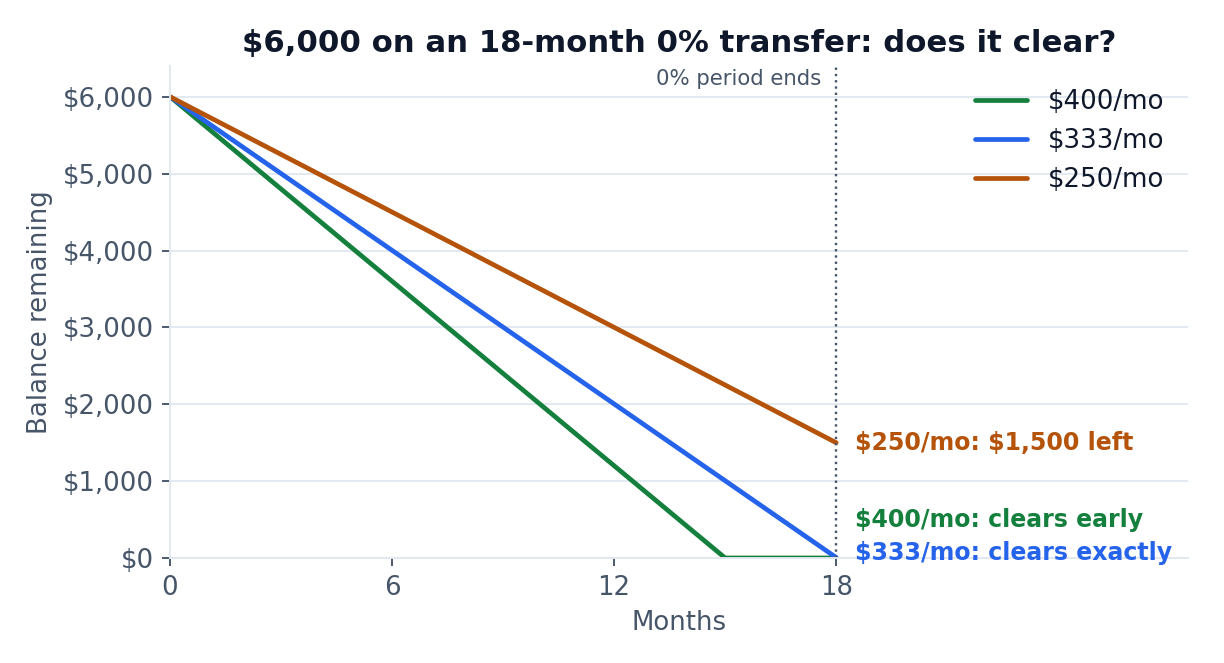
If months needed is larger than the 0% period, the transfer does not solve your problem - it postpones part of it to a revert rate that is typically somewhere around 20% to 26% p.a. The calculator above runs this against your real repayment figure and tells you plainly whether the debt clears in time.
A worked example
A $6,000 balance on an 18-month 0% offer needs $333 a month to clear exactly on time. Repay $400 and you finish early with room to spare. Repay $250 and you reach month 18 still owing about $1,500, which then starts accruing at the revert rate - and you have usually paid a transfer fee for the privilege.
The interest saved in the good version is real money: on $6,000 at around 21% p.a., roughly $1,000 over that period. The bad version saves most of that too, but hands you a fresh problem at the end with less motivation to solve it.
The traps worth knowing before you apply
- The transfer fee. Many offers charge 1% to 3% of the balance up front. On $6,000 that is $60 to $180, which comes straight off the interest you save. Include it before deciding.
- New purchases usually are not at 0%. On many cards, purchases on a balance-transfer card attract interest immediately, and repayments are often applied to the lowest-rate balance first. The safe approach is to treat the card as transfer-only and not spend on it at all.
- You usually cannot transfer within the same bank. Transfers are between different issuers, so the field of offers is smaller than it looks.
- It is a new credit application. That means a credit enquiry, and the new limit sits on your file. Applying for several at once is visible and unhelpful.
- The old card stays open unless you close it. An empty card with a live limit is how people end up with the original debt plus a new one.
When a balance transfer is the wrong tool
If you cannot make the repayment that clears the balance in the window, a transfer is a deferral rather than a fix, and rolling from one offer to the next gets harder each time. If the debt is large relative to income, or spread across several cards and a personal loan, the honest options are a consolidation loan or free financial counselling - the National Debt Helpline (1800 007 007) is free and independent. Nothing on this page is financial advice, and a comparison site is not the right place to solve a debt spiral.
Common questions
Does a balance transfer hurt my credit score?
The application creates an enquiry, which has a small short-term effect. Clearing the debt on schedule helps more than the enquiry hurts. Multiple applications in quick succession is the thing to avoid.
What happens at the end of the 0% period?
Any remaining balance starts accruing at the card’s revert rate, commonly in the low-to-mid twenties per cent. That is the number the calculator is protecting you from.
Can I do a second balance transfer afterwards?
Sometimes, with a different issuer, but each one costs a fee and another enquiry, and approval gets harder. Plan to clear it in one window.
Should I close the old card?
Usually yes, once the balance is moved, unless you have a specific reason to keep it. See what is a balance transfer for the full walkthrough.