
The cheapest way to spend money overseas from Australia is a debit card that charges no foreign transaction fee, with a multi-currency account for anything large. The expensive way is the credit card already in your wallet, which almost certainly adds about 3% to every purchase, and anything bought at an airport. On a $4,000 trip that difference is roughly $120 against nothing.
Last checked 21 September 2026. We have no commercial relationship with any provider named on this page. If that changes, it will be disclosed here.
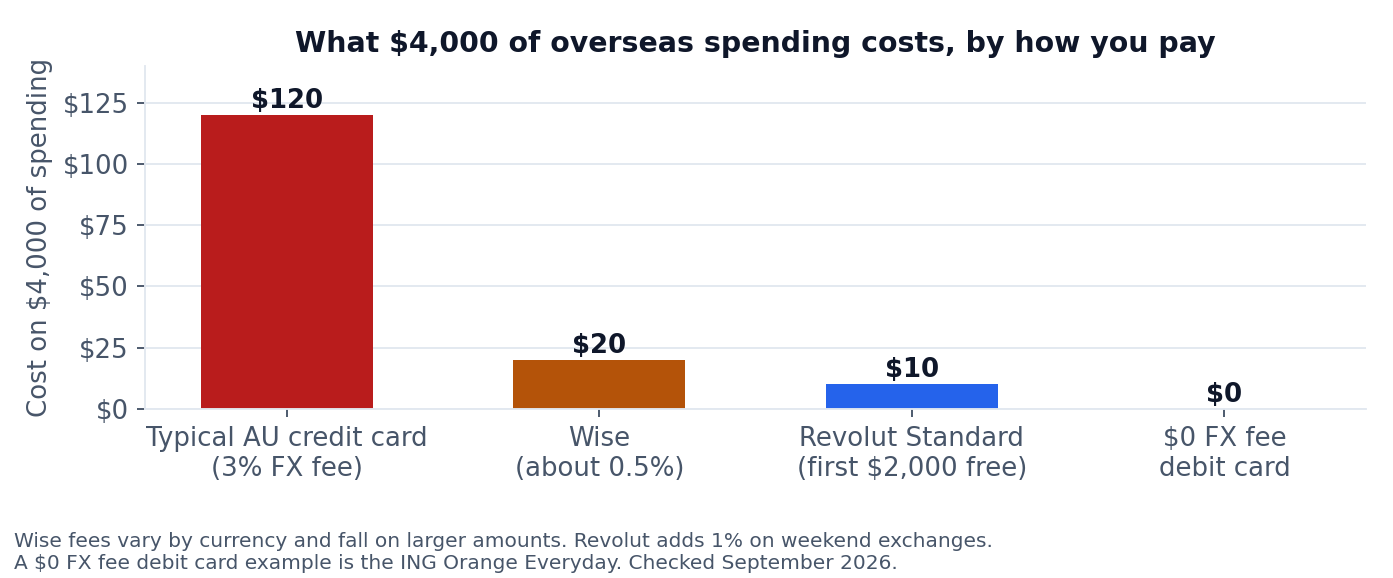
What each way of paying actually costs
Every method below moves the same money. The only difference is who takes a cut and how visible they make it.
| Method | What it charges | Cost on $4,000 |
|---|---|---|
| Typical Australian credit card | About 3% foreign transaction fee | ~$120 |
| Wise | Mid-market rate plus an explicit fee, usually well under 1% | ~$20 |
| Revolut (Standard plan) | Free to A$2,000 per rolling month, then 0.5% | ~$10 |
| Debit card with no FX fee | Nothing on the transaction itself | $0 |
| Airport or travel money card | A marked-up exchange rate, often plus load and inactivity fees | Worst of the lot |
The one that has quietly got better
Fee-free debit cards used to come with monthly hoops. The ING Orange Everyday was the well-known example: you had to deposit $1,000 from an external source and make five settled card purchases each month to earn the rebate.
That requirement is gone. From 15 October 2025 ING gives all Orange Everyday customers those benefits automatically, with no monthly eligibility criteria, covering both the international transaction fee and ING’s international ATM withdrawal fee. Several other Australian accounts sit in the same territory. If you already hold one of these and have been paying for overseas purchases with a rewards credit card out of habit, you have been paying roughly 3% for the privilege of earning about 1.5% back in points.
Wise and Revolut are not the same product
Wise converts at the real mid-market rate and charges a separate, visible fee, which varies by currency pair and falls on larger amounts. Nothing is buried in the rate. A physical card costs a one-off $10; the digital card is free.
Revolut’s Standard plan gives you fee-free exchange up to A$2,000 in each rolling month, then charges 0.5%. The catch that catches people is the timing: exchanges between 17:00 Friday and 18:00 Sunday US Eastern time carry an extra 1% for Standard customers. Convert on a Saturday and you pay a markup that would not apply on the Monday.
Broadly: Revolut suits smaller, regular spending inside its monthly allowance. Wise suits larger one-off conversions where its percentage falls away. The full comparison is in Wise vs Revolut Australia.
The mistake that costs more than any fee
When a foreign card terminal asks whether you want to be charged in Australian dollars or the local currency, always choose the local currency.
Choosing Australian dollars hands the conversion to the merchant’s payment processor instead of your card network. That is dynamic currency conversion, and the rate is set by whoever owns the terminal. Margins of 3% to 7% are ordinary, and they sit on top of whatever your card charges. It is presented as a convenience and it is the single most expensive button on the machine.
The same applies at ATMs and on hotel checkouts. If a screen offers you a “guaranteed” rate in AUD, decline it.
Cash and ATMs
Two fees stack on an overseas withdrawal: your own provider’s, and the local operator’s. Your provider’s is the one you control.
- Revolut Standard allows A$350 or five withdrawals per rolling month, whichever comes first, then charges 2% or A$1.50, whichever is greater.
- Wise gives a monthly free allowance before per-withdrawal and percentage fees apply. Wise changed its Australian ATM structure during 2026, so check the current figure in the app rather than trusting any article, including this one.
- ING rebates its own international ATM fee for Orange Everyday customers.
Practical version: withdraw larger amounts less often, decline the machine’s AUD conversion, and never use an airport ATM if a bank one is five minutes away.
A setup that works for most trips
- A no-FX-fee debit card as the default for everyday spending.
- A multi-currency account for larger conversions, funded before you leave rather than on the weekend.
- A backup card kept separately, in case one is lost or blocked.
- A small amount of local cash for the places that still want it.
Note what is not on that list: buying currency at the airport, and putting everyday purchases on a rewards credit card. If you want the points on overseas spend, check what the foreign transaction fee costs you first, because on most Australian cards it is roughly double what the points are worth. The no foreign transaction fee guide covers the exceptions.
Common questions
Should I buy foreign currency before I go?
Generally no. Retail currency exchange, especially at airports, is priced on a marked-up rate rather than a visible fee, which makes it hard to compare and usually the worst option available. Carry a small amount for arrival if it helps you feel comfortable, and get the rest from an ATM.
Are prepaid travel money cards worth it?
Rarely. They lock in a rate that already includes a margin, and they commonly add load, reload, ATM and inactivity fees. The locked rate is the selling point, and it is also how the margin is hidden.
Is a credit card ever the right choice overseas?
For the protections, sometimes. Chargeback rights and travel insurance attached to a card can be worth more than the fee on a large booking such as a flight or hotel. For daily spending, the fee wins and you should use something else.
Does my card earn points on overseas spending?
Usually yes, but at roughly 1 to 1.5% of value against a foreign transaction fee of about 3%. You are paying two dollars to earn one.
What about paying in Australian dollars to know the exact amount?
You pay a large premium for that certainty. See the dynamic currency conversion section above.